|
|||||
K-Dense Updates// July 24, 2026 |
|||||
|
Plenty of AI tools can produce a confident scientific answer. Far fewer can show you how they got there, or help you go find out whether it’s actually true. That gap is the thread running through everything below. Our new partnership with Litmus Science takes a hypothesis out of the browser and into a physical lab. Our head-to-head against Claude Science found our clearest advantage is producing work another scientist can audit and rerun. And this week’s two BYOK releases are largely about making research inspectable. |
|||||
>From Hypothesis to Wet LabK-Dense Web can search 250+ scientific databases, analyze your data, and design the experiment that would settle a question. What it cannot do is pick up a pipette. Our new partnership with Litmus Science is about closing that half of the loop. Litmus Science turns a well-specified experimental question into quotes from vetted labs – both robotics-run autonomous facilities and traditional CROs – usually within about a week, so you can compare cost, timeline, and fit before committing to anything. We’re now working to bring that directly into K-Dense Web, along with an MCP server that will let the agent scope and submit experiments programmatically.
|
|||||
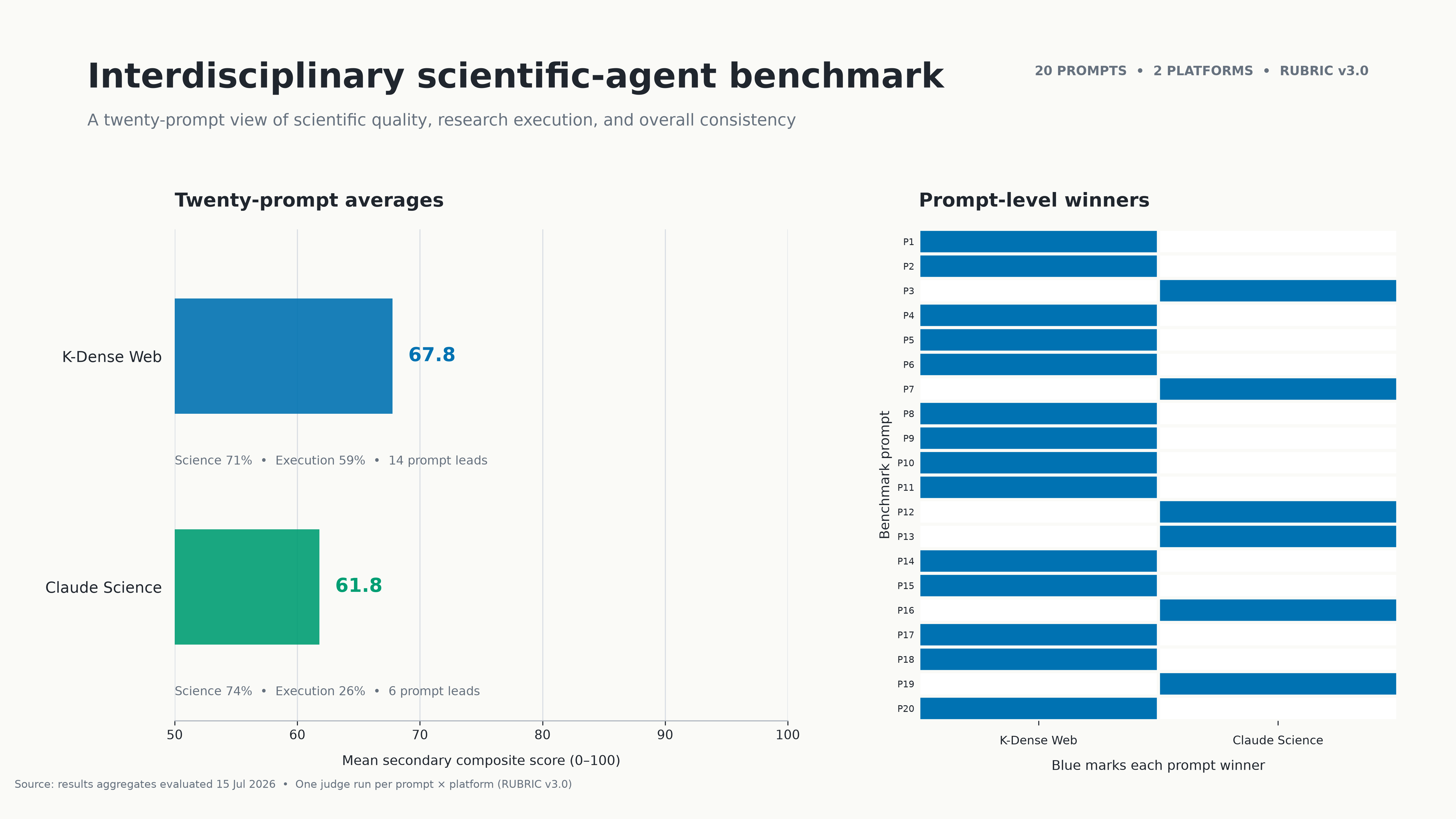
>K-Dense Web vs. Claude Science: 20 TasksWe ran both platforms through the same 20 scientific research tasks, scoring not just whether the answer was right but whether the work could be traced, reproduced, and rerun by someone else.
K-Dense Web led 14 of the 20 prompts and won research execution on all 20, averaging 14.7/25 against 6.4/25. The widest gaps were in whether an analysis could actually be regenerated and traced back to its sources – the difference between a result you can read and one you can rerun. We designed, ran, and judged this benchmark ourselves, so the writeup includes the full methodology, the complete prompt-level results, and the limitations. |
|||||
>BYOK v0.9.0: A Nature Medicine ReproductionK-Dense BYOK is our free, open-source co-scientist. It runs on your own desktop, powered by the accounts and API keys you choose, and your projects, notebooks, and results stay in ordinary folders on your machine. To show what it can actually do, we used it to reproduce a recent Nature Medicine publication end to end – the whole run, start to finish. Two releases shipped this week, v0.8.0 and v0.9.0. What they change for you at the bench:
|
|||||
>177 Research Sessions You Can InspectWondering what a full research session actually looks like? Our use case library spans science, finance and investment, engineering and technology, health and climate, and geopolitics and strategy. Recent additions range from mapping tau pathology pathways and auditing anti-tau therapeutics, to a techno-economic analysis of cultivated meat scale-up, to simulating the long-term orbital stability of the Beta Pictoris debris disk. Most include the full session and a downloadable PDF report, so you can inspect exactly how the work was done. |
|||||
>Build Your Own Agent Skills: Workshop RecordingMissed our agent skills workshop earlier this month? The recording is a beginner-friendly walkthrough: installing a ready-made skill, then building one from scratch, live. Worth an hour if you’ve been meaning to automate a piece of your own workflow. We especially appreciated everyone who stayed after the deck to show us their skills in practice – great work. |
|||||
|
|
|||||
|
One question before you go: if you could hand a single experiment to a lab this month, what would it be? Hit reply and tell us – we’re using those answers to decide what the Litmus Science integration should support first. |
|||||
|
Until next time, The K-Dense Team |



|
||
|