We asked K-Dense Web a deceptively simple question:
Do 116 newly declassified UAP files contain concrete evidence of extraterrestrial life?
The answer came back in the form of a full 60-page report, generated from a single prompt. K-Dense Web ingested the document corpus, wrote and executed the analysis scripts, extracted entities, counted evidence categories, ranked the most important incidents, generated 15 figures, compiled the final PDF, and ran a peer review pass on the output.
The headline finding is careful, and that is what makes it interesting:
The files document extensive unexplained aerial activity. They do not, on this corpus, contain concrete evidence of extraterrestrial biological life.
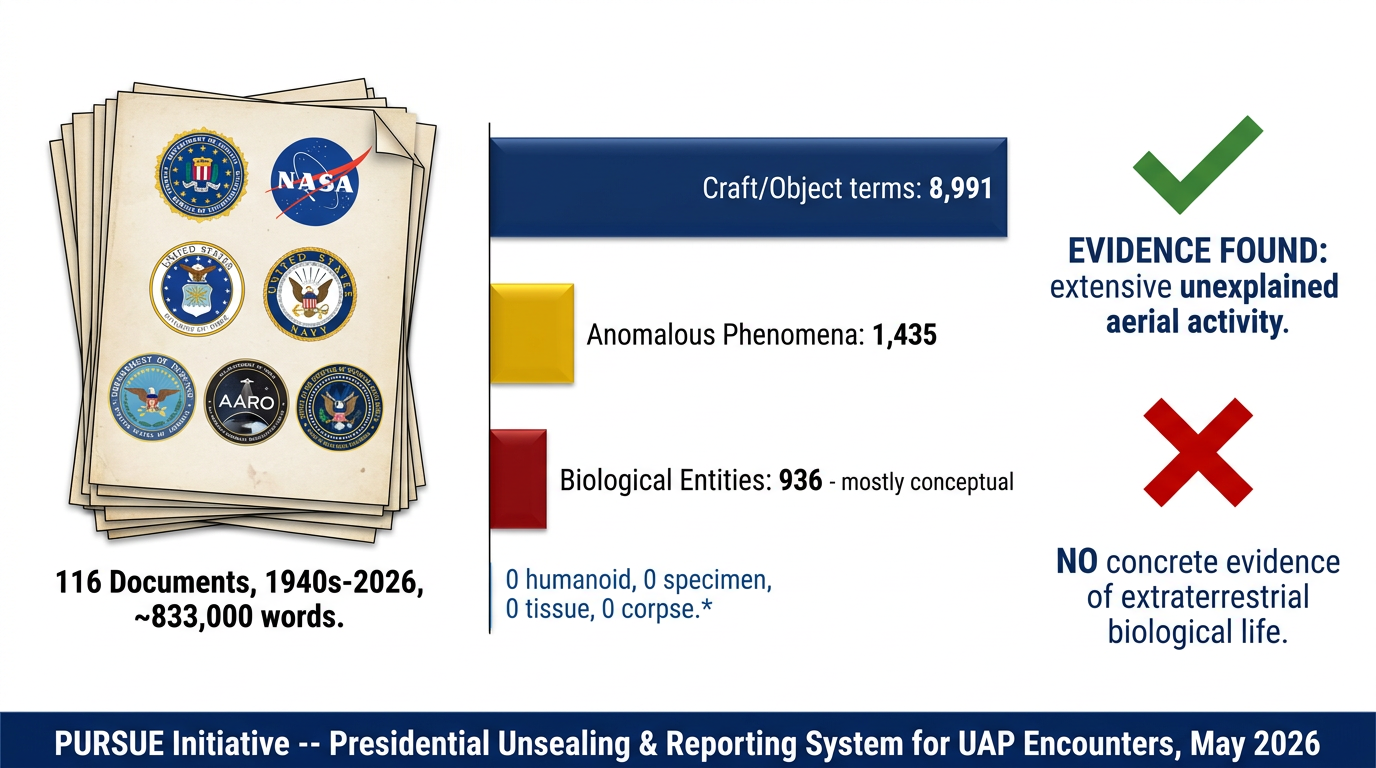
K-Dense Web analyzed 116 declassified UAP files spanning the 1940s to 2026. The corpus contains a large observational record, but concrete biological recovery vocabulary is absent.
The full PDF is available here: PURSUE UAP Report
What Was Analyzed
The corpus came from the May 2026 PURSUE release, a declassified document batch covering UAP and UFO records across agencies and eras. The files span roughly 833,000 cleaned words and include historical sighting reports, FBI correspondence, NASA transcripts, Department of War mission reports, AARO assessments, diplomatic cables, and an inter-agency Western U.S. event briefing.
K-Dense Web treated the question as a document-forensics problem rather than a belief problem. The goal was not to decide whether extraterrestrial life exists. The goal was narrower and more answerable: what do these files actually say?
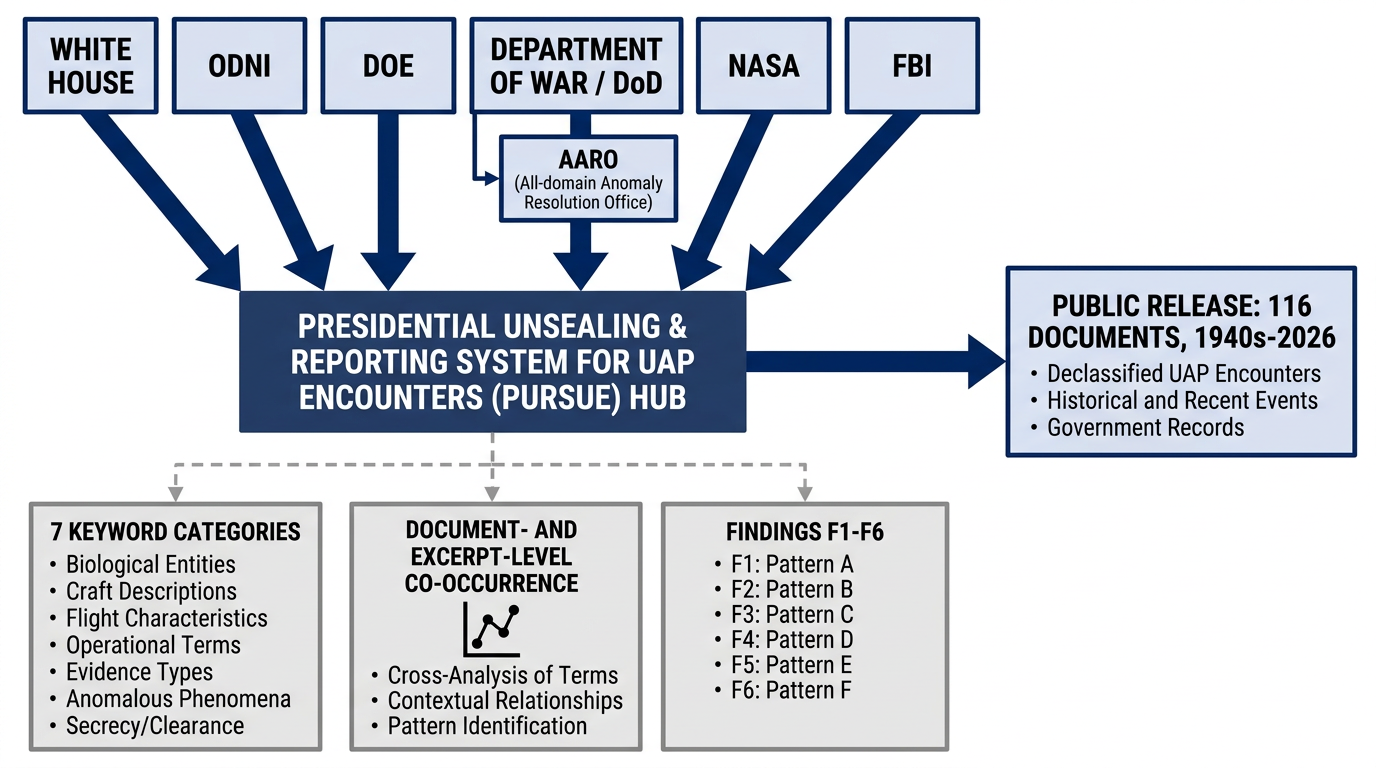
The report was produced as an end-to-end analytical pipeline, not as a manual essay. K-Dense Web structured the corpus, extracted entities, counted evidence categories, selected deep-dive incidents, synthesized findings, generated figures, and compiled the final PDF.
From one prompt, the system produced:
| Output | Result |
|---|---|
| Documents analyzed | 116 |
| Cleaned word count | 833,731 |
| Keyword categories | 7 |
| Keyword phrases | 176 |
| Named entity mentions | 60,124 |
| Deep-dive incidents | 18 |
| Figures | 15 |
| Final report | 60-page PDF |
| Peer review | Completed, no major revisions |
The Inference Ladder
The most useful idea in the report is the inference ladder. Many public UAP discussions collapse several different claims into one. A sighting becomes an object. An object becomes a craft. A craft becomes a non-human craft. A non-human craft becomes biological extraterrestrial intelligence.
Those are not the same claim.
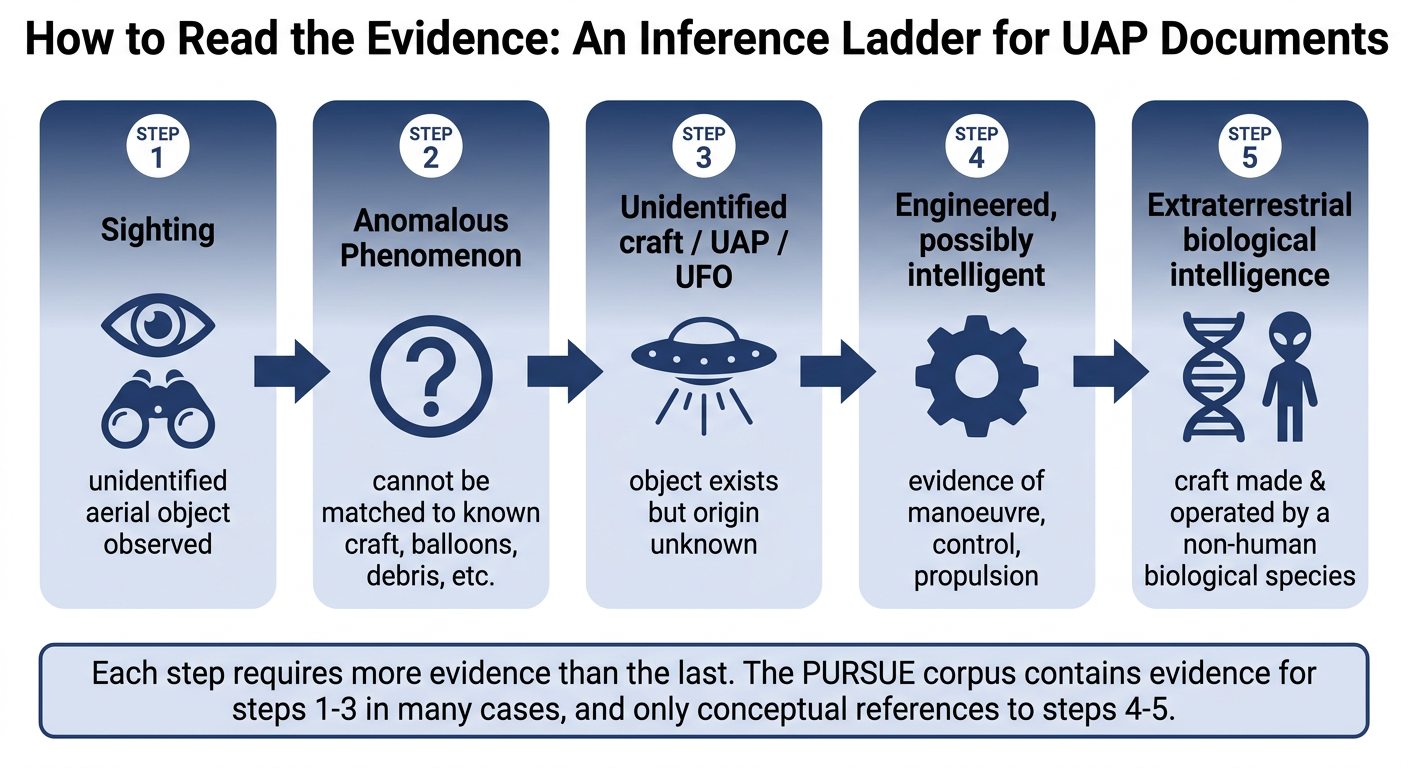
The report separates weaker and stronger claims. The PURSUE corpus contains many examples at the lower rungs and some cases that plausibly reach the engineered-or-controlled rung. It does not contain evidence that reaches the extraterrestrial biological intelligence rung.
This distinction is the backbone of the analysis. The corpus contains many credible reports of things that trained observers could not identify. Some modern operational records are genuinely strange. But the much stronger claim, that these documents contain evidence of extraterrestrial biological life, requires a different kind of vocabulary and a different kind of record.
It would look like chain-of-custody language. It would look like recovered material. It would mention specimens, tissue, occupants, biological remains, autopsy, laboratory analysis, or recovery teams.
That language is not there.
The 10-to-1 Imbalance
K-Dense Web counted seven categories of language across the full corpus:
| Category | What it captures |
|---|---|
| Craft descriptions | UFO, UAP, object, craft, disc, light, orb, vehicle |
| Flight characteristics | Altitude, velocity, maneuver, hover, formation |
| Operational terms | Mission, report, intercept, patrol, exercise |
| Evidence types | Witness, photograph, radar, debris, recovered, specimen |
| Anomalous phenomena | Unidentified, unexplained, anomalous, glowing |
| Biological entities | Alien, being, extraterrestrial, biological, humanoid, occupant |
| Secrecy and clearance | Classified, redacted, top secret, declassified |
The imbalance is the core quantitative result.
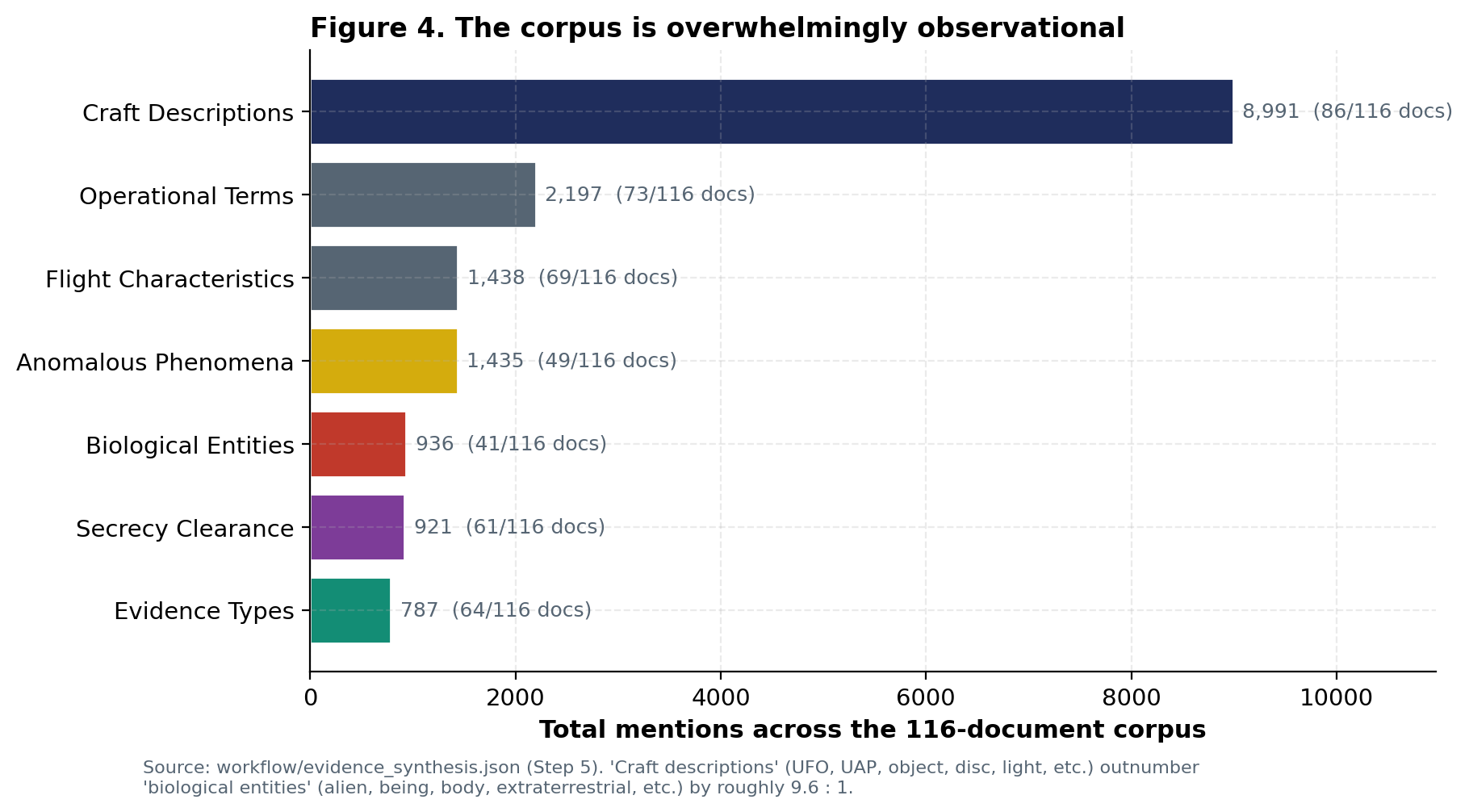
Craft/object descriptions appear 8,991 times across the corpus. Biological-entity vocabulary appears 936 times. The ratio is 9.61 to 1.
Craft and object language dominates because these are, overwhelmingly, records about things in the air. Objects, lights, discs, orbs, vehicles, flight paths, radar tracks, and witness statements appear again and again.
Biological vocabulary is much rarer, and when it does appear, it is usually not physical.
That is the first important lesson: the PURSUE files are not empty. They are not a nothingburger. They show a long, multi-agency, multi-decade record of unexplained aerial observations. But the corpus is observational, not biological.
The Words That Matter Most Are Missing
The most striking figure in the report is not just about the words that appear. It is about the words that do not.
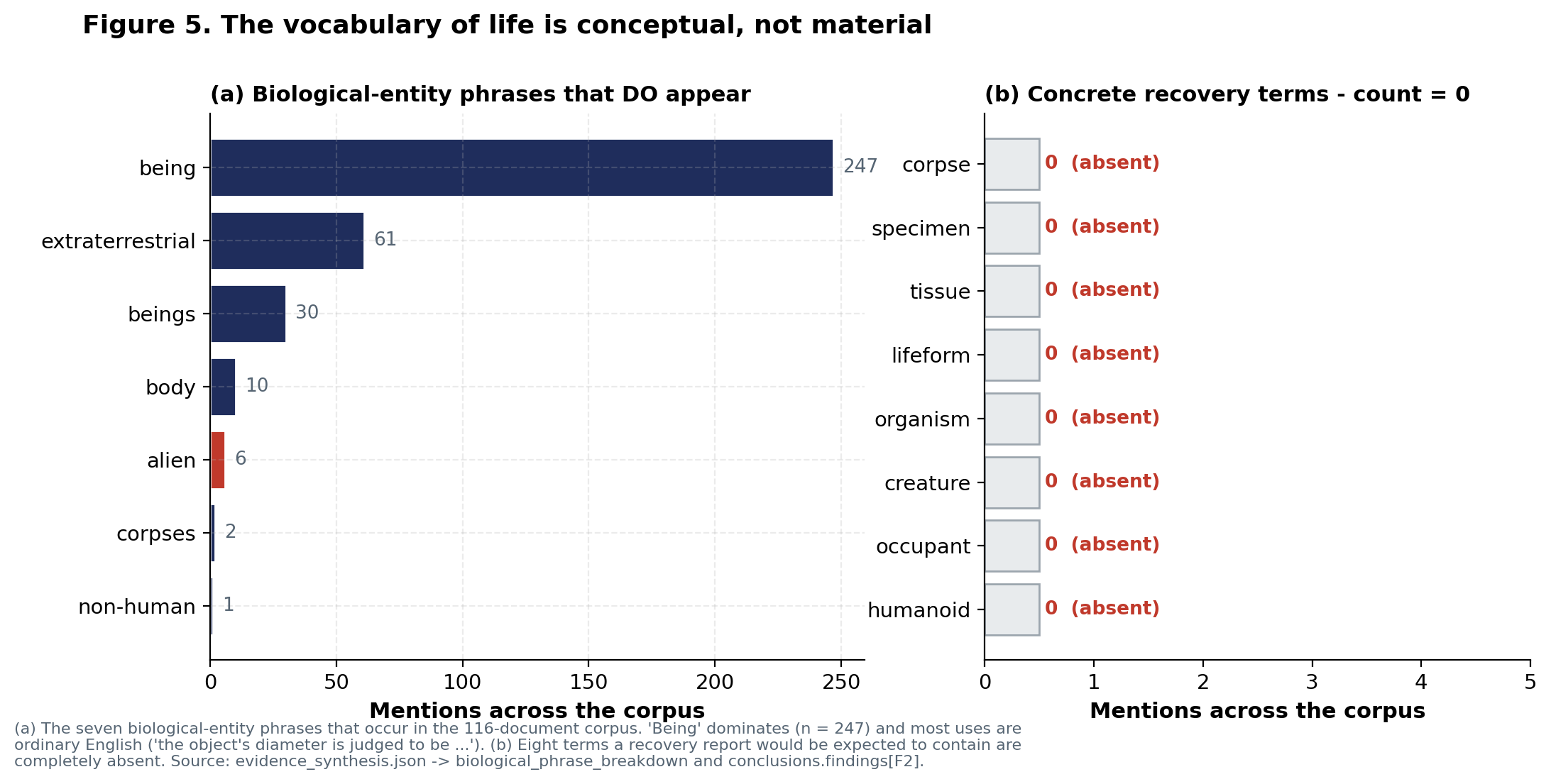
The biological vocabulary that does appear is mostly conceptual or ordinary English. The concrete recovery terms a biological report would be expected to contain are absent.
Across 833,731 words:
| Term | Count | Context |
|---|---|---|
| being | 247 | Mostly ordinary English, as in "the object being..." |
| extraterrestrial | 61 | Mostly in a NASA-archived analytical study discussing the hypothesis |
| beings | 30 | Mostly public correspondence in FBI files |
| body | 10 | Often phrases like "body of the report" or technical body-axis language |
| alien | 6 | Concentrated in the Mexico congressional hearing cable |
| corpses | 2 | Same Mexico cable, reporting a public claim |
| non-human | 1 | Same Mexico cable |
The report then checked the terms one would expect in an actual biological recovery record:
| Recovery term | Count |
|---|---|
| humanoid | 0 |
| occupant | 0 |
| creature | 0 |
| organism | 0 |
| lifeform | 0 |
| tissue | 0 |
| specimen | 0 |
| corpse | 0 |
This absence is hard to hand-wave away. These are not exotic words. They are ordinary words used by coroners, biologists, military recovery teams, laboratories, and investigators when biological material is present.
The report is careful about what this means. It does not prove that no such evidence exists anywhere. It says that this declassified corpus does not contain it.
The One Document That Almost Talks About Bodies
There is exactly one place in the corpus where the phrase "alien corpses" appears.
It is not a recovery report.
It is a diplomatic cable describing the September 2023 Mexican congressional hearing where alleged alien bodies were presented by Jaime Maussan. The same cable notes that previous similar presentations had been discredited by scientists.
That matters because the document is not saying "we recovered alien corpses." It is saying "a foreign political event included claims about alien corpses, and those claims are contested."
This is the difference between a document recording a claim and a document establishing a fact.
Where Biological Language Lives
The co-occurrence analysis answers a useful question: when biological language appears, what else is around it?
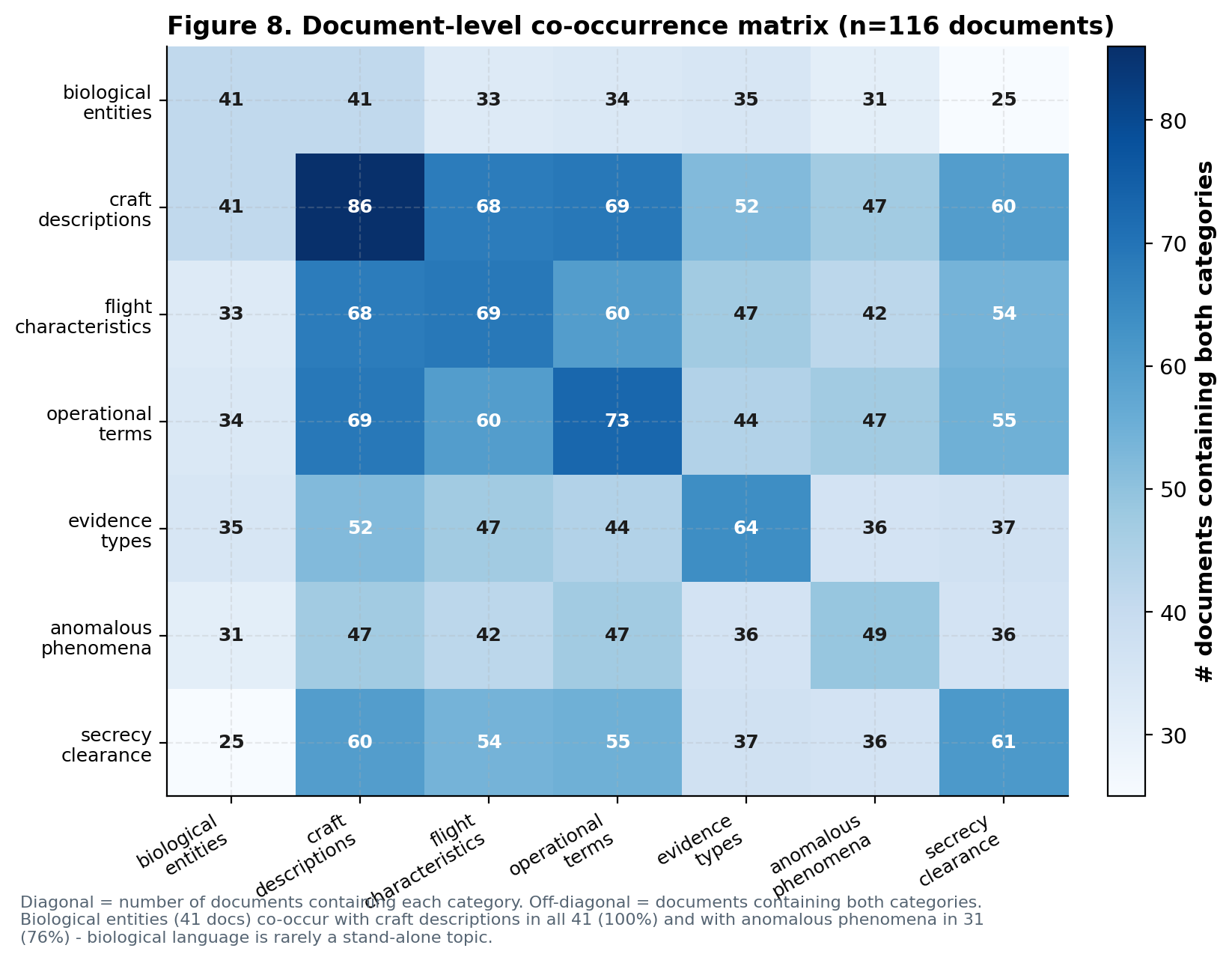
Biological-entity language appears in 41 documents. In all 41, craft-description language also appears. Biological language is embedded in sighting, policy, or hypothesis contexts rather than appearing as a stand-alone recovery category.
At the document level, biological language is tightly coupled to craft and anomalous-phenomena language. That sounds dramatic until you inspect the passages. The pattern is usually something like:
A report discussing the "extraterrestrial hypothesis" in relation to UFOs.
Or:
A member of the public writing to the FBI about "beings from outer space."
Or:
A phrase where "being" is simply a participle, as in "the object being observed."
The Jaccard similarity analysis tells the same story from another angle.
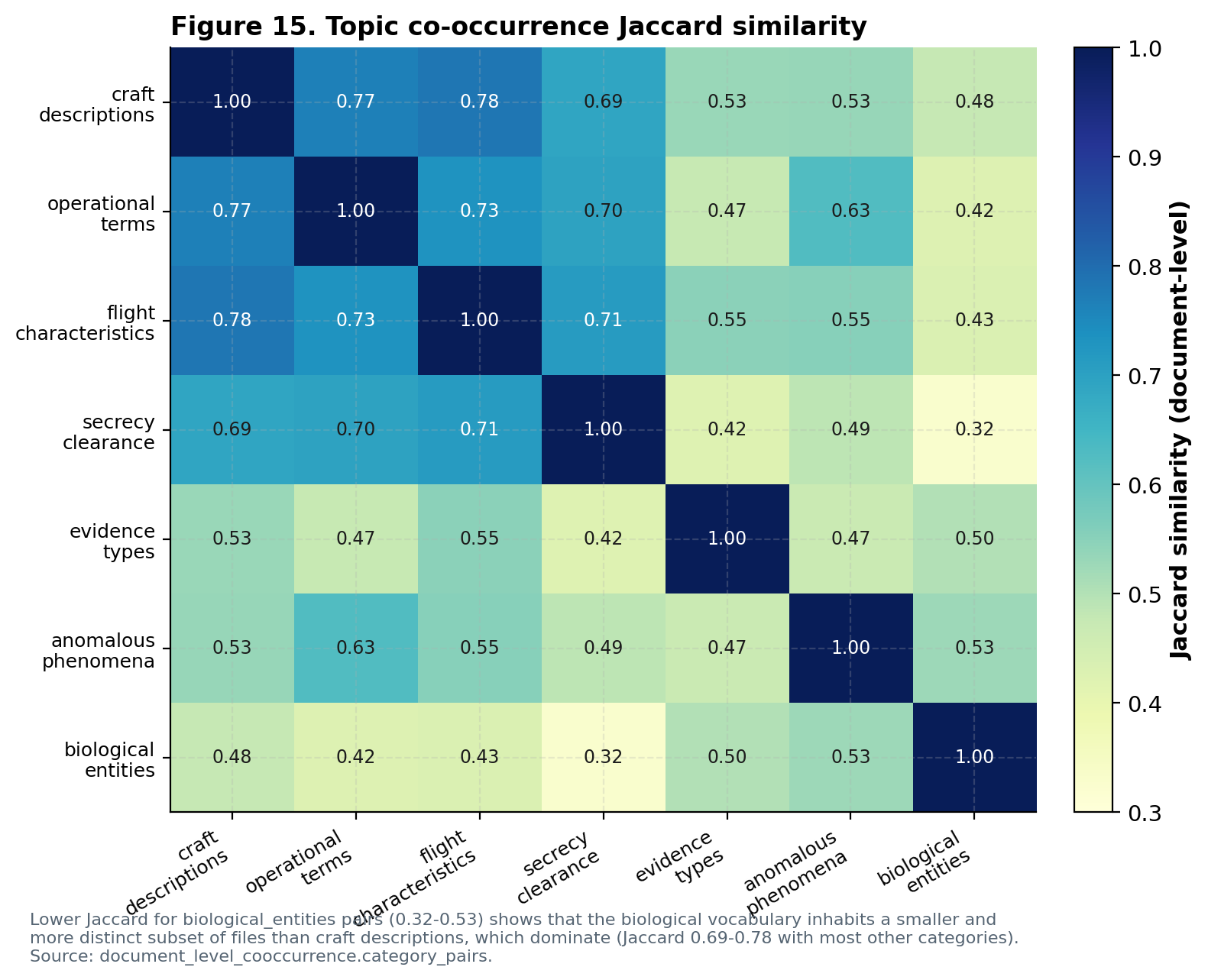
Craft-description categories have the strongest overlaps. Biological vocabulary inhabits a smaller, more distinct subset of files.
Even at the excerpt level, biological language rarely appears alone.
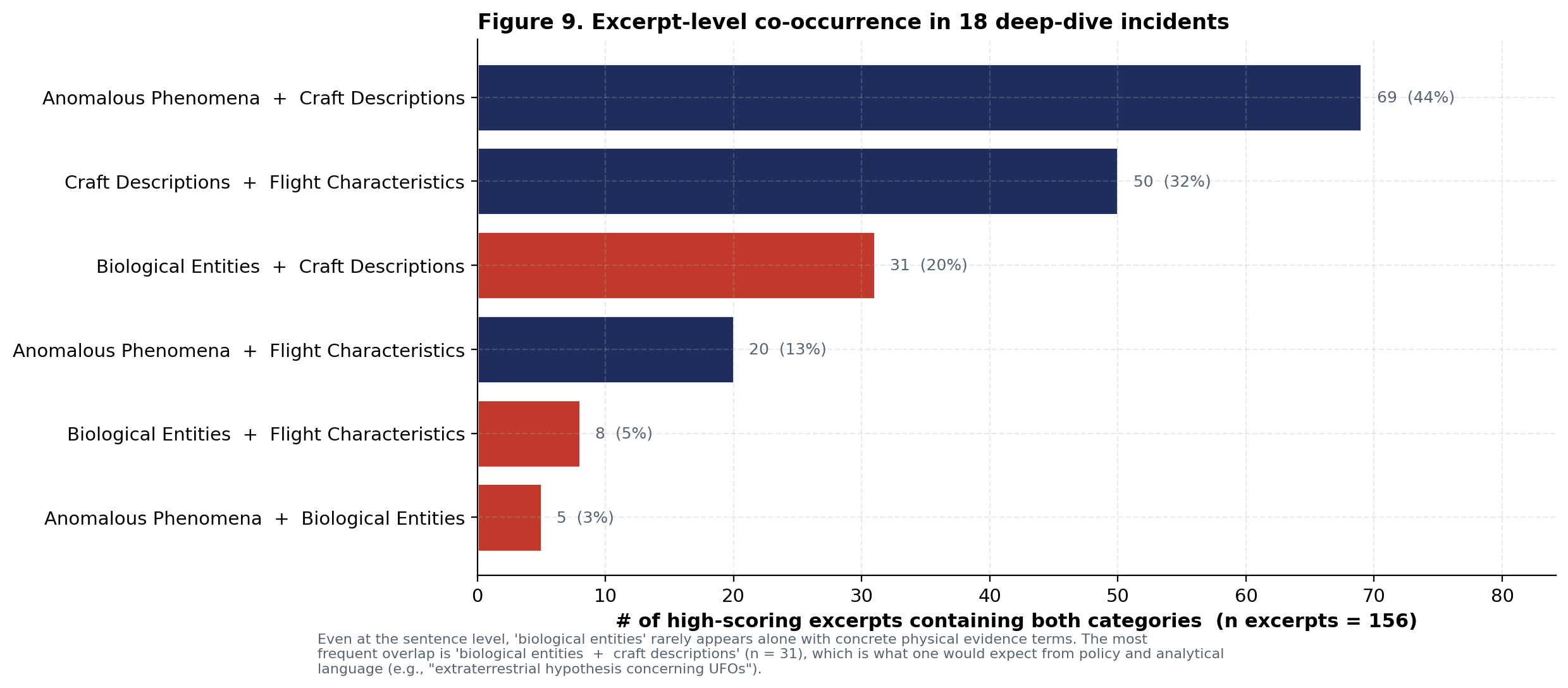
In the 18 deep-dive incidents, the most common excerpt overlaps are observational: anomalous phenomena plus craft descriptions, and craft descriptions plus flight characteristics.
This is the structural signature of the corpus: biological language is about UAP discourse, not UAP recovery.
Agencies Tell Different Stories
The agency breakdown is another important sanity check.
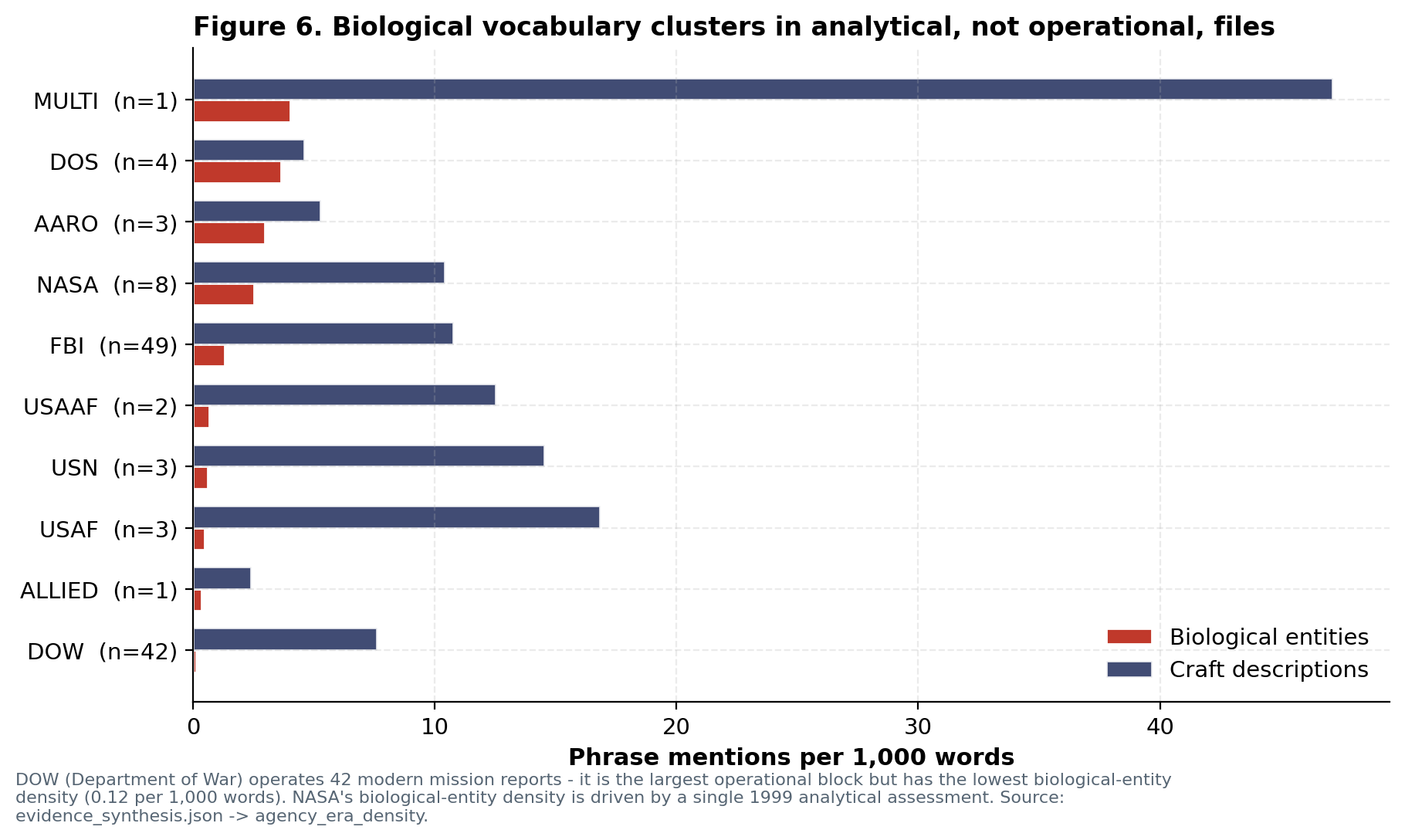
The Department of War, which contributes the largest modern operational block, has the lowest biological density. Analytical and correspondence-heavy files carry more biological vocabulary.
The Department of War contributed 42 modern operational documents, including mission reports and range-fouler debriefs. These are the files one might expect to contain first-hand field evidence if such evidence had been released.
They do not. Their biological-entity density is the lowest in the corpus: 0.12 mentions per 1,000 words.
NASA has higher biological density, but the reason is a single large analytical study, the 1999 NASA-archived COMETA report, which discusses the extraterrestrial hypothesis as a hypothesis. The FBI has biological vocabulary largely because it preserved decades of public correspondence, including letters from UFO enthusiasts and contactee figures.
That is very different from an agency saying, "we found biological material."
The era analysis adds a second layer.
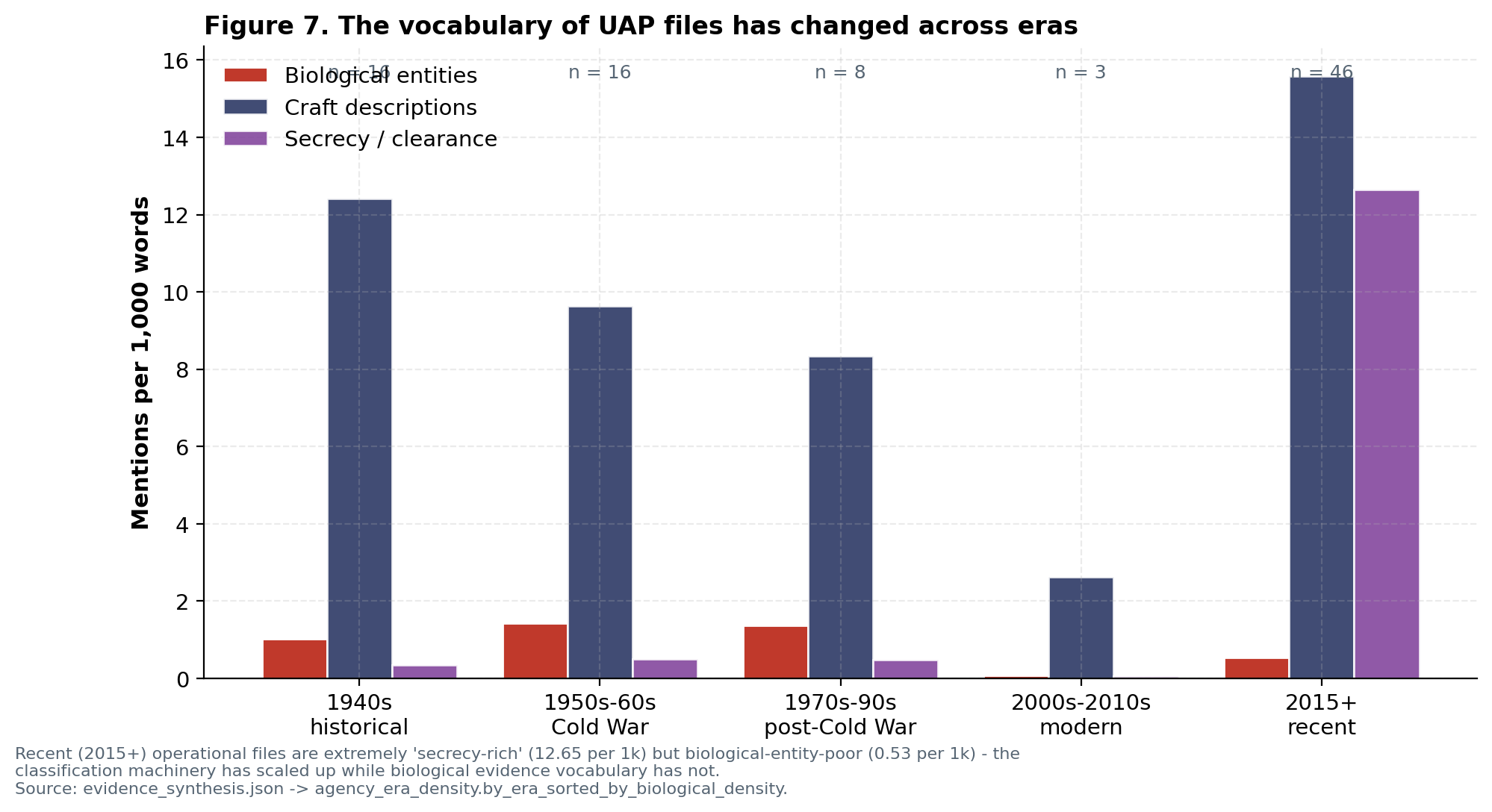
Modern records have more classification and template language. Older records are more narrative. Biological vocabulary does not increase over time in a way that would suggest accumulating physical evidence.
The 2015+ era is the most modern and operationally relevant. It is also extremely secrecy-heavy, largely because modern mission reports repeat classification headers and caveats. But secrecy vocabulary is not evidence by itself. In this corpus, the modern records are procedural, templated, and observational.
The Most Interesting Incidents
K-Dense Web selected 18 deep-dive incidents that together captured the most important anomaly and evidence signals across the corpus.
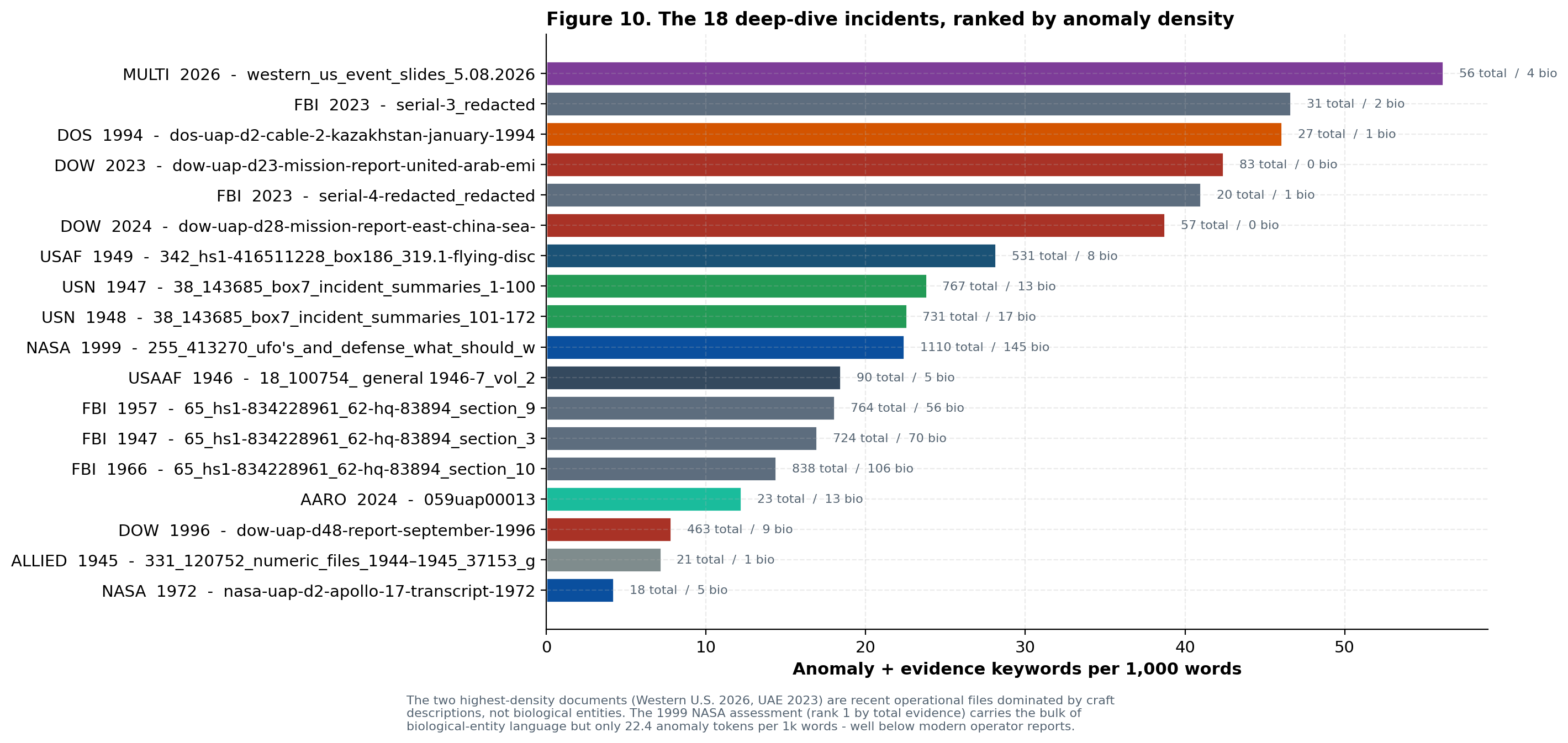
The 18 deep-dive documents cover NASA, FBI, USN, USAF, DOW, DOS, AARO, Allied WWII material, and a 2026 inter-agency briefing.
Some of the documents are genuinely fascinating:
The 1947 U.S. Navy Box 7 incident summaries catalog roughly 233 sightings from the first wave of modern flying-disc reports. They are careful, structured, and historically important. They show that the government was taking the reports seriously almost immediately.
The Allied 1944-45 Foo fighter file shows that unexplained aerial lights predate the "flying saucer" era. The first working hypothesis was not extraterrestrial life. It was a possible foreign-state weapon.
The 2023 UAE mission report records a Reaper sortie that observed two UAP over several hours. It is operationally credible and interesting, but it does not contain a biological claim.
The 2024 East China Sea mission report includes a provocative observation that an object may have detached from the primary UAP before leaving the sensor field of view. Again, interesting. Again, not a recovery claim.
The 2026 Western U.S. briefing is probably the most memorable modern document. It describes multiple federal law-enforcement agents observing orange orbs that seem to launch smaller red orbs, a large fiery orb near a rock pinnacle, a dark kite-like object, and a transparent kite-shaped object visible through night-vision goggles.
The report does not dismiss these events. It says they support the lower rungs of the inference ladder, and in some cases maybe partial rung 4. They do not support rung 5.
That is the discipline of the analysis.
The Apollo Folklore Check
One of the most useful parts of the report is the Apollo transcript analysis.
A recurring claim in UFO culture is that NASA astronauts saw extraterrestrial craft and that the recordings were suppressed or reinterpreted. The PURSUE release includes Apollo and Skylab transcript material, so K-Dense Web checked it directly.
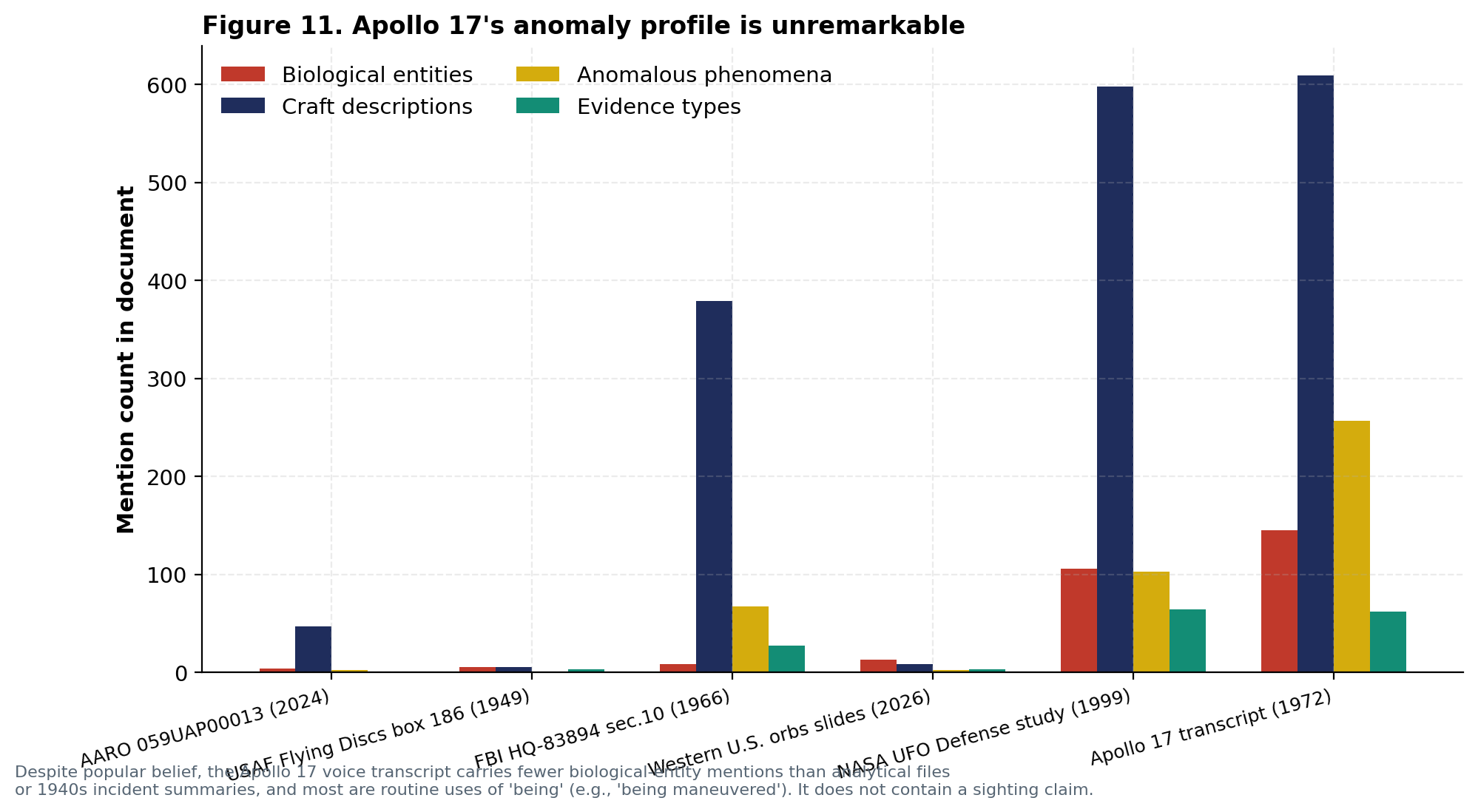
Apollo 17 is unremarkable in the deep-dive set. Its biological mentions are routine uses of "being", and the transcript does not contain a UAP claim.
The Apollo 17 transcript is dominated by spacecraft operations: navigation calls, fuel-cell purges, antenna configuration, booster separation, and ordinary mission chatter. The most suggestive object discussion concerns fragments after S-IVB separation, which the crew itself describes as likely ice chunks or paint flakes.
The report's conclusion is plain: the PURSUE-released Apollo material does not support the astronaut-UFO folklore claim.
The Map Is Wide, But the Claim Is Narrow
The corpus spans a lot of geography: Cold War U.S. sightings, Pacific and West Coast records, Middle East operational reports, East China Sea reporting, Mexico City diplomatic cable traffic, and more.
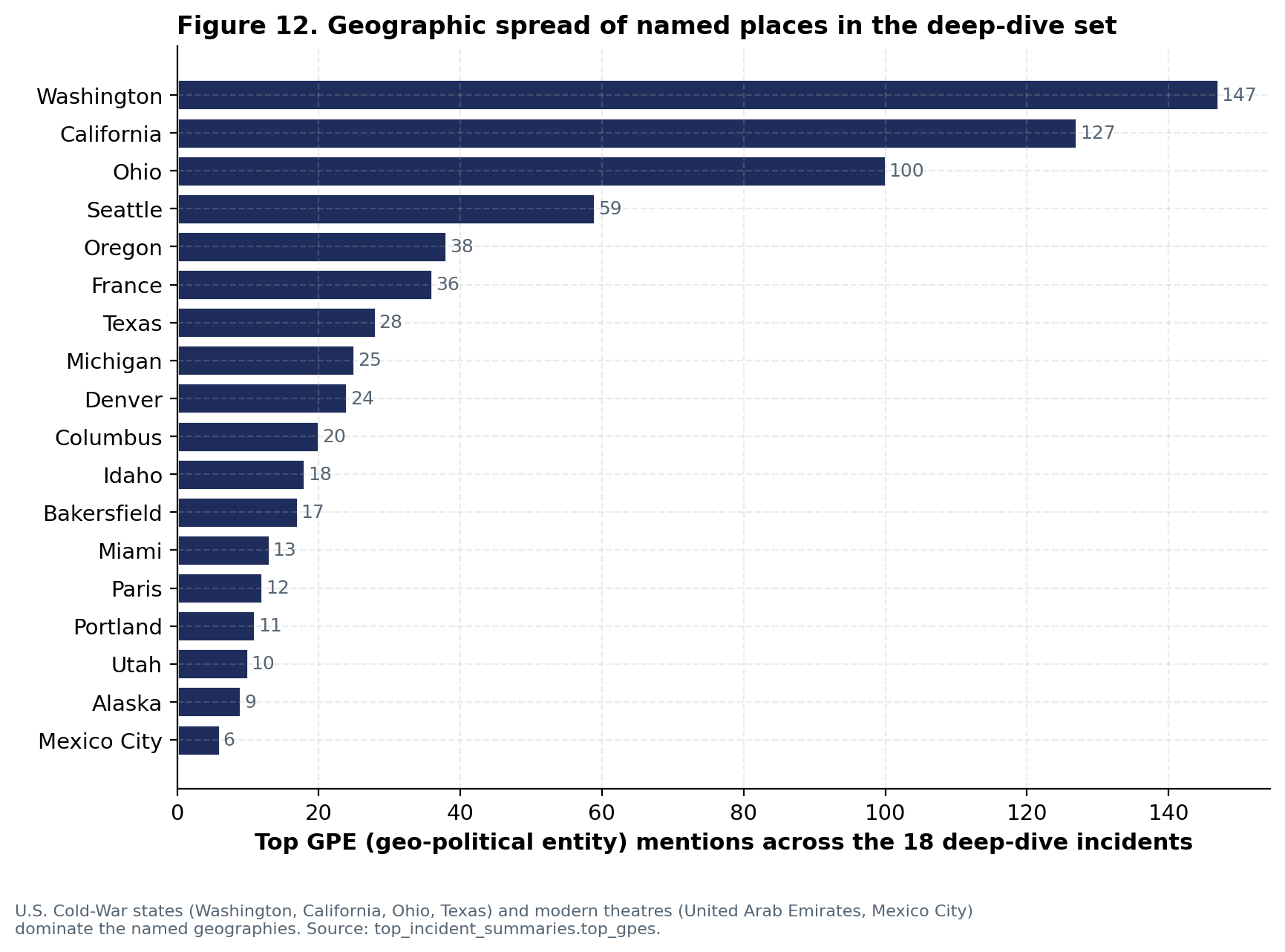
The deep-dive set covers historical U.S. sighting centers and modern operating theaters. The geographic breadth reinforces that the corpus is not a single local anomaly.
That breadth is one reason the report is not dismissive. The files show that unexplained aerial observations are durable, multi-decade, multi-agency, and geographically distributed.
The mistake is to treat that as the same thing as confirmed extraterrestrial biology.
It is not.
The Verdict
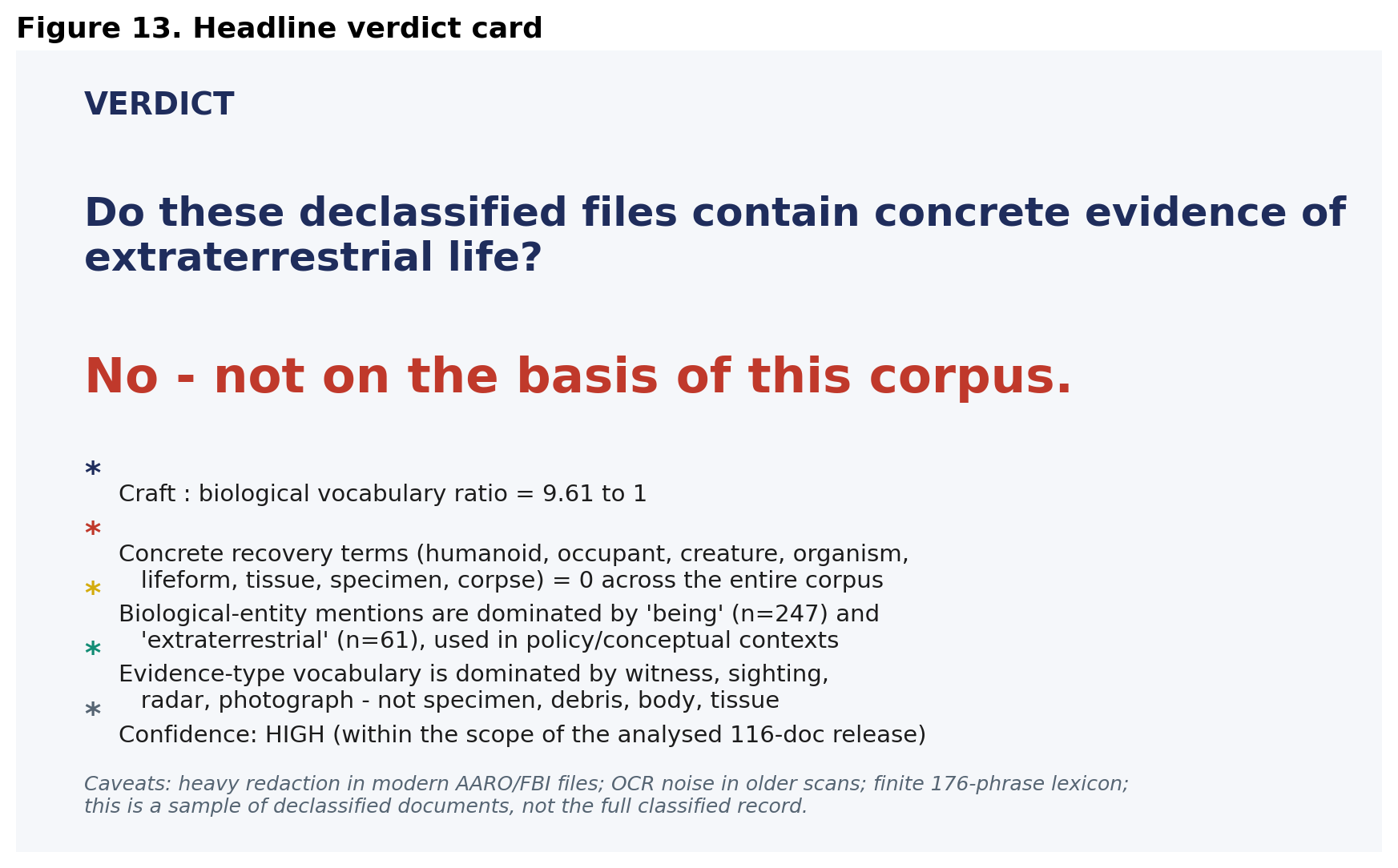
The final verdict is high confidence within the scope of the 116-document corpus. It is not a claim about the entire classified record.
The final answer:
No, not on the basis of this corpus.
Why:
- Craft and object language outnumbers biological language by 9.61 to 1.
- The biological vocabulary that appears is mostly conceptual, quoted, or ordinary English.
- Concrete biological recovery terms are absent.
- The one "alien corpses" passage is a diplomatic cable reporting a discredited public claim.
- Biological vocabulary appears inside sighting, policy, and hypothesis contexts, not recovery records.
The caveats matter too. Redactions may hide information. OCR noise can distort older files. A finite keyword lexicon can miss unusual phrasing. And this is a declassified subset, not the entire classified record.
But within the corpus actually released, the pattern is strong.
Why This Is a Good K-Dense Web Example
This is exactly the kind of problem K-Dense Web is built for.
The question was not answered by vibes, speculation, or a one-paragraph model response. It required:
- Reading a large document corpus.
- Turning messy files into structured data.
- Creating a transparent methodology.
- Quantifying competing evidence categories.
- Separating direct evidence from reported claims.
- Preserving caveats without losing the conclusion.
- Producing a public-facing report with figures and citations.
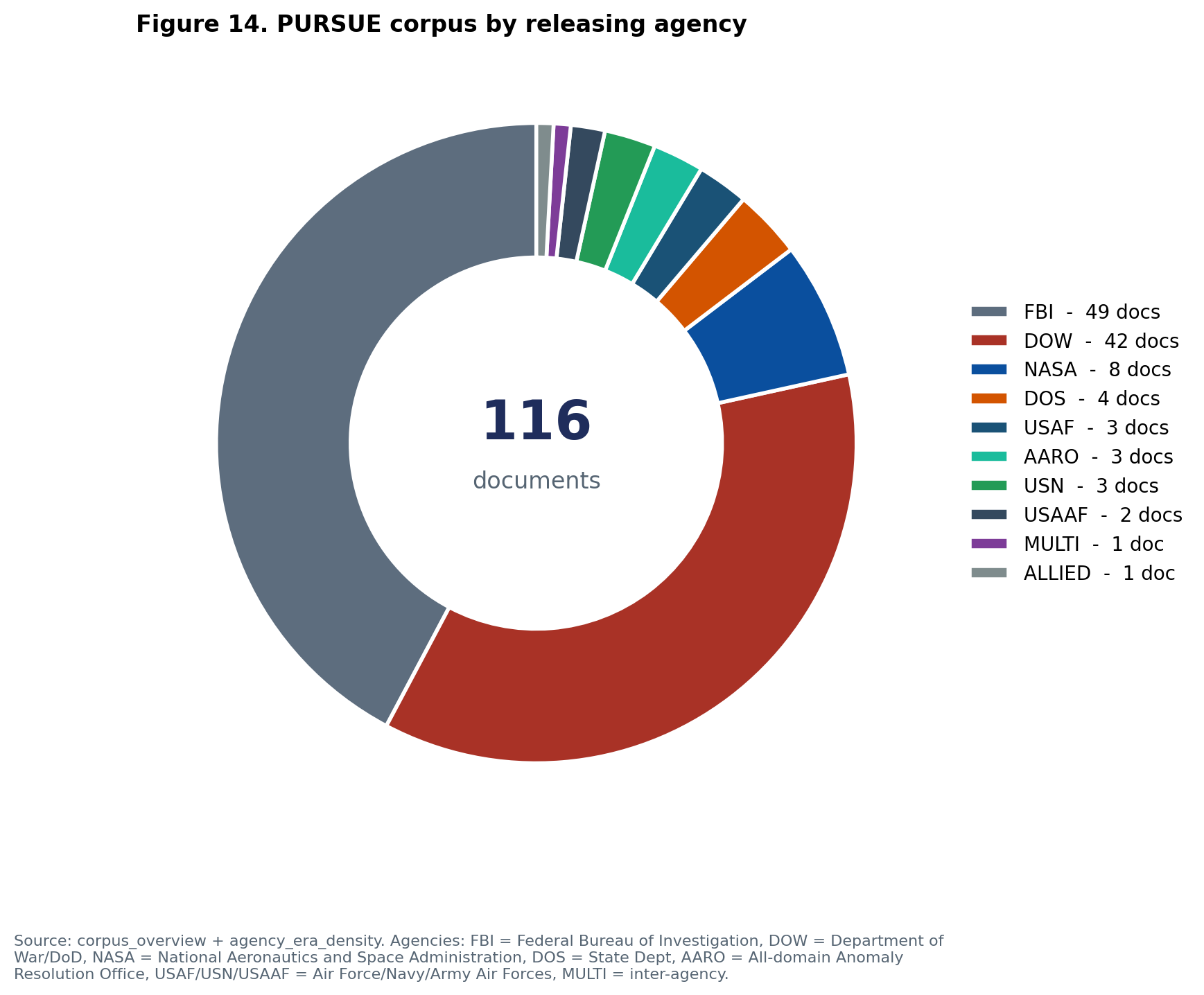
The corpus spans historical, scientific, diplomatic, law-enforcement, and military records. That heterogeneity is exactly why a structured pipeline matters.
The final report is interesting because it resists both easy narratives.
It does not say "nothing happened." Too much happened. The documents include credible, repeated reports of unexplained aerial activity over many decades.
It also does not say "therefore extraterrestrial life." The documents do not support that jump.
The best summary is the report's own concluding idea: there is a real phenomenon-class here, and we do not yet understand it. The PURSUE release is valuable because it lets the public inspect the record. The record, at least in this first 116-document batch, shows observation without recovery, mystery without confirmation, and evidence without the strongest claim people often want it to carry.
That is a more interesting result than either extreme.
Read the full report: PURSUE UAP Report