What this research found
Transcriptomes from 213 kidney tumor samples were compared to ask three questions about clear cell renal cell carcinoma (ccRCC): whether the pathways targeted by standard therapies are genuinely dysregulated, which patients look least likely to respond, and what might be offered to them instead. All four target pathways were significantly dysregulated, and 13 of the 97 ccRCC samples (13.4%) scored as predicted non-responders to every drug class. Those 13 share no common molecular signature, pointing to resistance that arises through different mechanisms in different patients.
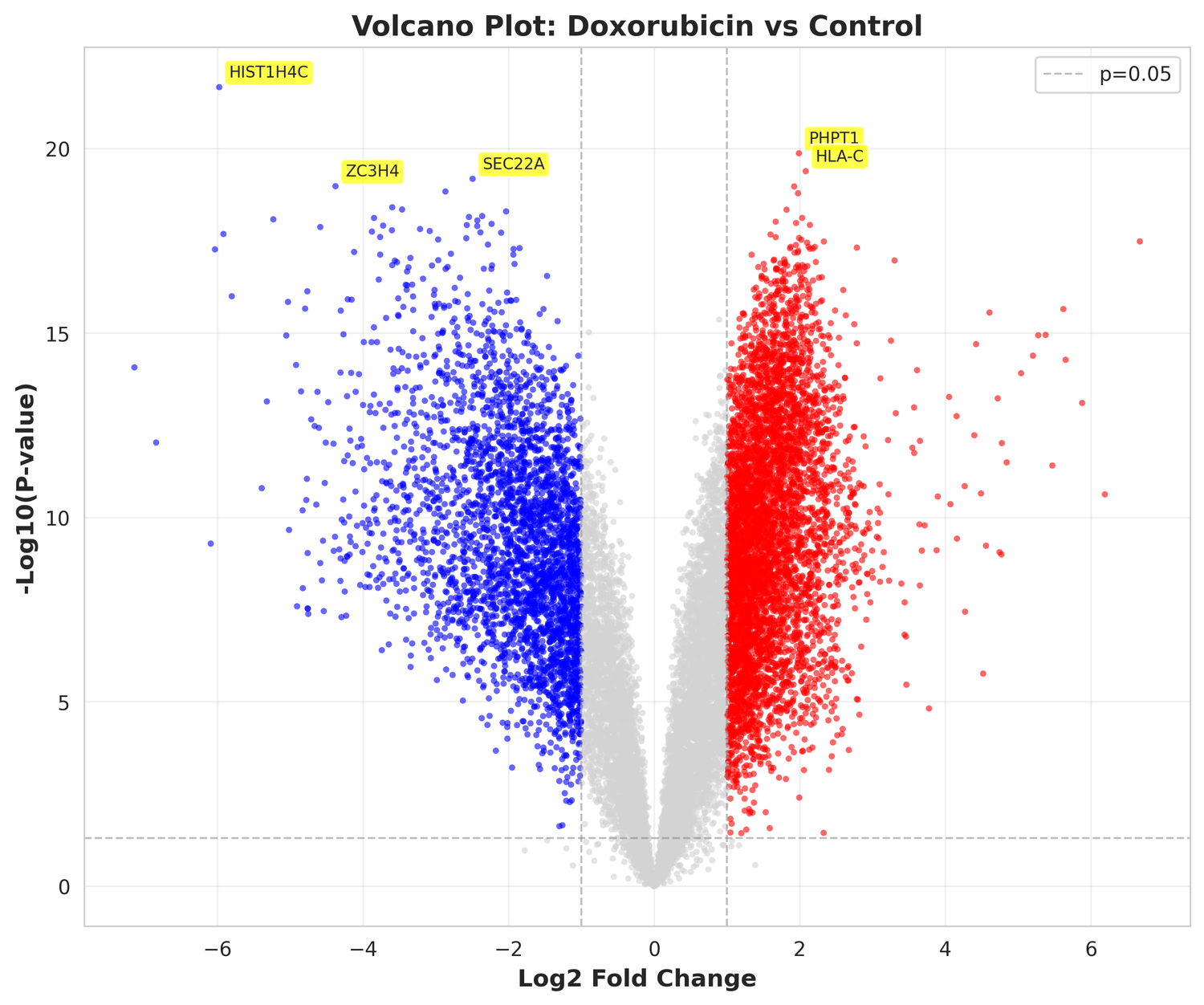
- ccRCC differs from other renal cell carcinoma subtypes on a very broad front: 29,573 of 52,598 tested genes (56.2%) were differentially expressed at FDR below 0.05 with an absolute log2 fold change above 1.0, split almost evenly between 15,287 upregulated and 14,286 downregulated.
- Every pathway behind a standard drug class was significantly dysregulated: angiogenesis up (Cohen's d = 0.466), mTOR signaling up (d = 0.690, p = 4.97×10⁻⁶), MET signaling up (d = 0.875, p = 8.29×10⁻⁹) and immune checkpoint signaling down (d = -0.784, p = 2.76×10⁻⁷). MTOR was the most strongly upregulated single target at log2FC = 2.04.
- Scoring the 97 ccRCC samples across the four drug classes yielded 4 samples predicted to respond to three or more classes (4.1%), 80 responding to one or two (82.5%), and 13 responding to none (13.4%).
- The 13 predicted non-responders have no signature in common. 217 genes reached nominal significance at p below 0.01 with fold changes up to 7.8, but none survived multiple-testing correction (all FDR above 0.6), and none of the 251 drug signatures tested against the Drug Signatures Database was enriched, the best reaching only an adjusted p of 0.945.
- Even with 29,573 differentially expressed genes, over-representation testing of the top 1,000 against ChEA, ENCODE and TRRUST returned no transcription factor at FDR below 0.05, which the authors read as distributed regulation rather than control by a few master regulators.
- The predicted response rates are not usable as efficacy estimates: a fixed 70th-percentile cutoff forces 29.9% for every class, which lands near the published objective response rates for VEGF inhibitors (35%) and checkpoint inhibitors (25%) but far above the 5–10% reported for mTOR inhibitors.
How it was done
Two ARCHS4 RNA-sequencing collections — 117 general renal cell carcinoma samples and 110 clear cell samples across 67,186 genes — were quality-filtered to 213 samples and 53,072 genes, then compared with PyDESeq2. A knowledge base of 18 molecular targets spanning the VEGF, immune checkpoint, mTOR and MET drug classes was checked for differential expression, and Hallmark gene sets were used to score pathway activity with Cohen's d effect sizes. Composite per-patient scores combining target expression and pathway activity classified each of the 97 ccRCC samples as a likely responder to each class at a 70th-percentile cutoff. The 13 patients failing all four classes were then compared with the other 84 using Wilcoxon rank-sum tests and screened against a drug signature database for repurposing candidates, yielding HIGD2B, galectin-7 and GOT1L1 as leads for future functional work rather than as validated targets.
Data sources
- ARCHS4 mined RNA-seq compendium (Lachmann et al., Nature Communications 2018) — 117 renal cell carcinoma and 110 clear cell samples, 213 retained after quality filtering
- MSigDB Hallmark gene sets for pathway activity scoring
- ChEA 2016, ENCODE TF ChIP-seq 2015 and TRRUST transcription factor databases via Enrichr
- DSigDB Drug Signatures Database — 251 drug signatures tested
- Published objective response rates from the sunitinib, nivolumab, cabozantinib and temsirolimus trials
Limitations
Responder labels come from expression-based scores with a fixed percentile cutoff rather than from clinical outcomes, so the same 29.9% response rate falls out for every drug class and cannot be read as a prediction of real-world efficacy. The non-responder group contains only 13 patients, too few to detect a resistance signature with confidence, and bulk RNA sequencing cannot resolve variation within a tumor or follow resistance as it develops.
Figures from this analysis
What this would have cost
This session was one of 67 audited against what a qualified specialist would spend producing the same deliverable alone, at mid-market US consulting rates.
Order-of-magnitude estimates (±30%) by design. The human baseline assumes one specialist working full-time without queueing or meetings, and excludes data and software licensing. The K-Dense figure is the credits a session consumed, valued at the Plus rate. What you are actually charged is capped per run — $9 at Standard, $29 at Pro — so the real gap is wider than shown. Full methodology.
How this research was produced
K-Dense Web planned and ran this cancer biology investigation end to end — gathering the sources, carrying out the analysis, producing the figures, and drafting the report. The full session transcript, including every intermediate step, is available to view.