What this research found
An investment due diligence package on Structure Therapeutics (NASDAQ: GPCR) and its lead asset GSBR-1290, also called aleniglipron, an oral non-peptide GLP-1 receptor agonist in Phase 2 for obesity and type 2 diabetes. Target validation, 280 active competitor trials, FDA adverse-event reports, patent filings, and market sizing were pulled together into a 52-page report with scenario valuation. The verdict was a speculative buy: a weighted risk-adjusted net present value of $2.0 billion against a market capitalization of roughly $800 million, with the first-half 2026 Phase 2b readout treated as a binary event.
- Weighted risk-adjusted net present value comes to $2.0 billion against a market capitalization near $800 million. The base case assumes $6.5 billion in peak sales at 50% probability, alongside a $10.0 billion bull case and a $2.5 billion bear case at 25% each.
- Market sizing narrows a $963 billion total addressable market of US adults with obesity or type 2 diabetes to an $87 billion serviceable market of diagnosed, treated, oral-preferring patients, and then to a $6.5 billion obtainable market at 7.5% share.
- The differentiation case rests on dosing form rather than potency: GSBR-1290 is positioned as the only oral weekly GLP-1 agonist in development, with no fasting requirement (unlike oral semaglutide) and no need for peptide carrier technology. The target itself is well validated, with 15 approved drugs acting on GLP1R.
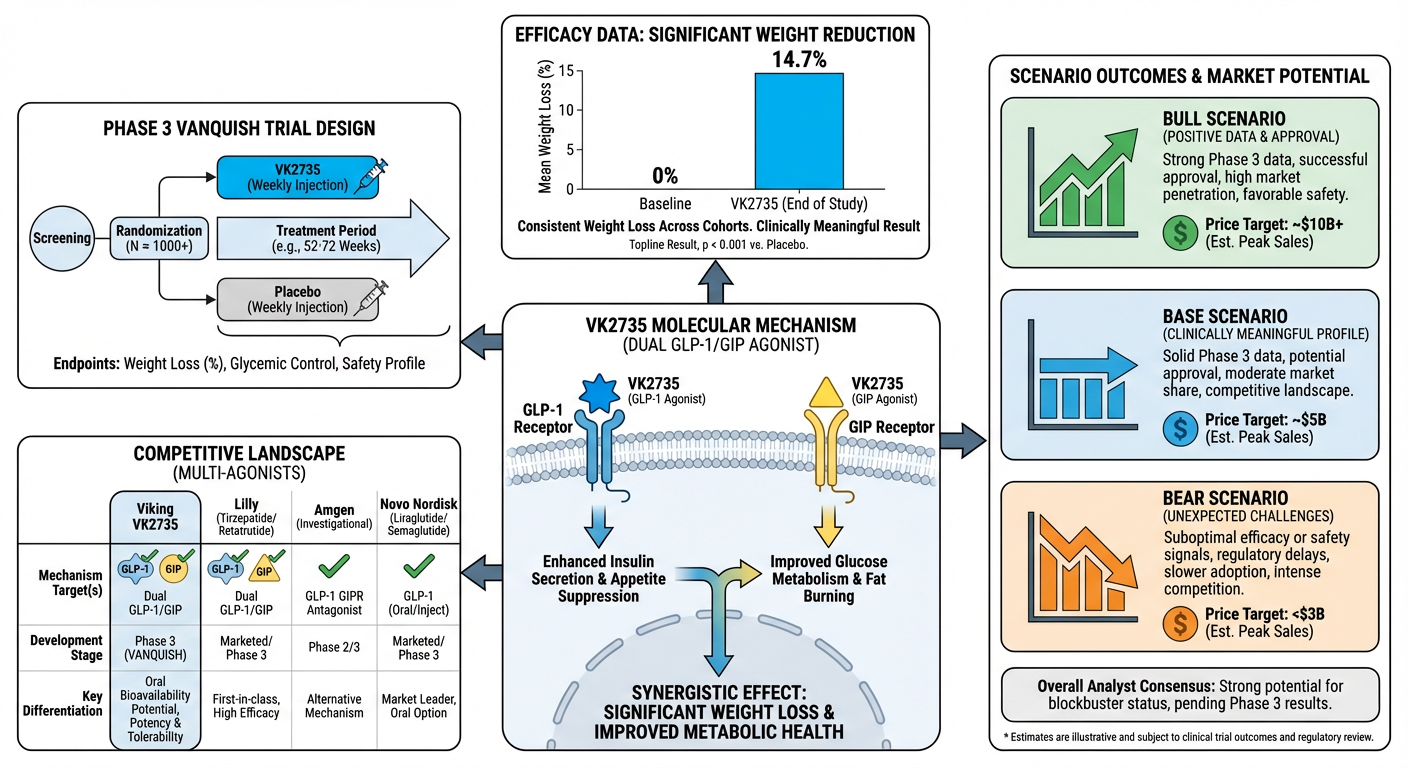
- Competition is the binding constraint, scored 4.0 out of 5 alongside commercial risk, against 3.2 for clinical and 2.6 for regulatory risk. Eli Lilly's orforglipron sits 12 to 18 months ahead in Phase 3, with approved products from Novo Nordisk and Lilly and Viking's VK2735 also in Phase 3.
- Gastrointestinal tolerability is a class problem rather than a company-specific one. Nausea appears in 14.90% of semaglutide adverse-event reports, 14.43% of liraglutide's, and 9.93% of tirzepatide's, while pancreatitis is the outlier at 6.57% for liraglutide against 2.67% and 1.18%.
- Patent protection is strong but narrow: composition-of-matter claims run to 2040–2043, a 14 to 17 year exclusivity runway, from a portfolio of about five families with low freedom-to-operate risk.
How it was done
Public data was assembled from six sources: GLP1R target validation from Open Targets, 280 active competitor trials from ClinicalTrials.gov, adverse-event reporting rates from OpenFDA's Adverse Event Reporting System, patent filings from USPTO and WIPO, literature and preprints from PubMed and bioRxiv, and company filings from SEC EDGAR. Those inputs fed a market sizing funnel, a Porter's Five Forces and SWOT assessment, risk scores across clinical, regulatory, commercial, and competitive categories, and probability-weighted net present value scenarios. A weighted scorecard across market opportunity, differentiation, competitive position, intellectual property, and execution produced 6.85 out of 10. The output was a 52-page report with 16 figures.
Data sources
- Open Targets Platform — GLP1R target validation and genetic evidence
- ClinicalTrials.gov — 280 active GLP-1 trials for the competitive landscape
- OpenFDA FAERS, January 2026 — 103,579 tirzepatide, 73,857 semaglutide, and 48,805 liraglutide adverse-event reports
- USPTO and WIPO — Structure Therapeutics and competitor GLP-1 patent filings
- SEC EDGAR company filings, plus PubMed and bioRxiv literature
Limitations
The work rests on publicly available information as of January 2026, and the valuation depends on peak-sales figures and scenario probabilities that are estimates rather than measurements. GSBR-1290's own tolerability remains unproven: the safety benchmark comes from competitor adverse-event reports, which reflect reporting behavior and market exposure rather than true incidence.
Figures from this analysis
What this would have cost
This session was one of 67 audited against what a qualified specialist would spend producing the same deliverable alone, at mid-market US consulting rates.
Order-of-magnitude estimates (±30%) by design. The human baseline assumes one specialist working full-time without queueing or meetings, and excludes data and software licensing. The K-Dense figure is the credits a session consumed, valued at the Plus rate. What you are actually charged is capped per run — $9 at Standard, $29 at Pro — so the real gap is wider than shown. Full methodology.
How this research was produced
K-Dense Web planned and ran this biotech investment investigation end to end — gathering the sources, carrying out the analysis, producing the figures, and drafting the report. The full session transcript, including every intermediate step, is available to view.