What this research found
Epigenetic clocks estimate biological age from DNA methylation, but what drives the methylation changes they measure is largely unknown. This analysis took the 866 CpG sites behind the Horvath and PhenoAge clocks, annotated them against ENCODE transcription-factor binding data, built a regulatory network to rank the upstream proteins controlling them, and screened those proteins for existing drugs. POLR2A, MYC, CTCF and E2F4 came out as the top regulators, and five already-approved drugs — led by the HDAC inhibitor vorinostat — hit proteins in that network.
- Clock CpG sites sit in active regulatory DNA. Of the 825 sites that could be mapped to coordinates, 697 (84.5%) overlap a transcription-factor binding site and 503 (61.0%) fall in a promoter within 2 kb of a transcription start site.
- RNA polymerase II subunit POLR2A overlaps 475 clock sites (57.6%), followed by MAX at 265 (32.1%), TAF1 at 264 (32.0%) and MYC at 250 (30.3%) — implicating the core transcriptional machinery and the MYC network rather than any aging-specific factor.
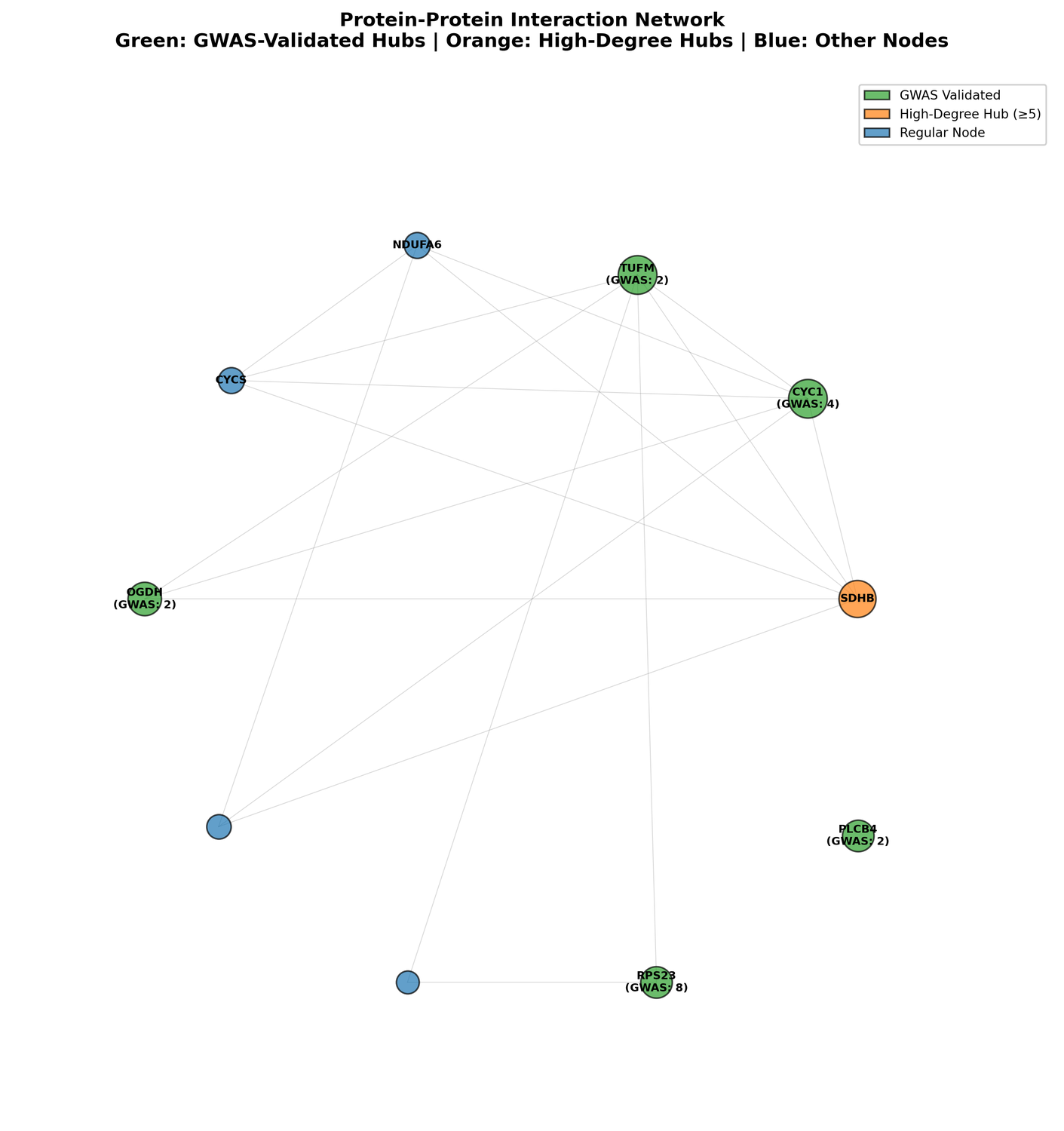
- A combined regulatory and protein-interaction network of 11,939 edges across 891 proteins ranked POLR2A (degree 471), MYC (259), CTCF (210) and E2F4 (176) highest by degree plus betweenness centrality.
- 26 of the 50 top-ranked regulators (52%) have documented drug interactions: 107 high-quality interactions across 81 compounds, of which five are FDA- or EMA-approved — vorinostat, romidepsin, tranylcypromine, tazemetostat and palbociclib.
- Independent testing in whole blood from 656 people aged 19 to 101 recovered all 866 sites; 580 (67.0%) shifted with age in the direction the clock coefficients predict, and 402 (46.4%) were both correctly directed and significant at p < 0.05. Horvath sites replicated better (75.6% directional) than PhenoAge sites (61.0%).
- Conventional pathway enrichment found almost nothing: of 1,528 KEGG and Reactome pathways tested, only sialic acid metabolism cleared a 5% false-discovery threshold (FDR = 4.62e-02).
How it was done
CpG coefficient lists were retrieved from the original supplementary data for four published clocks, but only Horvath (353 sites) and PhenoAge (513 sites) proved publicly downloadable, giving 866 sites in total. These were mapped to hg19 coordinates via Illumina 450K and EPIC array manifests, then intersected with UCSC gene and CpG island annotations plus 4,638,420 ENCODE transcription-factor ChIP-seq regions covering 161 factors. The resulting 11,372 factor-to-site associations were merged with STRING protein interactions scoring 400 or above into a network, ranked by degree and betweenness centrality to nominate master regulators. The top 50 regulators were screened against ChEMBL for drug interactions with approval status verified by hand, the sites were re-tested against an external blood methylation cohort, and the results were assembled into a 15-page manuscript proposing a four-layer model running from aging signals through transcription factors and chromatin modifiers to methylation.
Data sources
- Horvath multi-tissue clock — 353 CpG sites, Genome Biology 2013 supplementary data
- PhenoAge clock — 513 CpG sites, Levine et al., Aging 2018 supplementary data
- ENCODE transcription-factor ChIP-seq clustered peaks — 4,638,420 binding regions, 161 factors
- UCSC refGene annotations and CpG island tracks (hg19/GRCh37)
- Illumina 450K and EPIC array manifests
- STRING protein-protein interactions, confidence score 400 or above
- ChEMBL drug-target interactions
- GSE40279 (Hannum et al., 2013) — whole-blood methylation from 656 individuals aged 19 to 101
Limitations
Two of the four intended clocks could not be obtained — GrimAge coefficients are proprietary and the Hannum supplementary table was access-restricted — so the work covers 866 of a planned 1,967 sites, and a further 41 sites failed coordinate mapping. Validation rested on one cross-sectional blood dataset, and because the ENCODE binding data pools many cell lines the regulatory links indicate potential rather than demonstrated control of age-related methylation.
What this would have cost
This session was one of 67 audited against what a qualified specialist would spend producing the same deliverable alone, at mid-market US consulting rates.
Order-of-magnitude estimates (±30%) by design. The human baseline assumes one specialist working full-time without queueing or meetings, and excludes data and software licensing. The K-Dense figure is the credits a session consumed, valued at the Plus rate. What you are actually charged is capped per run — $9 at Standard, $29 at Pro — so the real gap is wider than shown. Full methodology.
How this research was produced
K-Dense Web planned and ran this epigenetics investigation end to end — gathering the sources, carrying out the analysis, producing the figures, and drafting the report. The full session transcript, including every intermediate step, is available to view.