What this research found
Should a low-cost CYP2C19 genotyping assay use a single universal three-variant core, or add population-specific variants on top? Genotypes for 2,504 people across 26 populations in the 1000 Genomes Project were used to measure how much actionable variation the standard core covering star alleles 2, 3 and 17 actually captures. The core is technically near-perfect and flags a variant in 62.4% of people worldwide, but its yield ranges from 82.4% in one South Asian population down to 18.8% in Peruvians, which motivated a universal core paired with explicit, pre-specified triggers for escalating to add-on variants or whole-gene sequencing.
- The three-variant core is technically clean: no Hardy-Weinberg deviations across 96 tests after false-discovery correction, zero genotype missingness, and each variant tags its star allele with a positive predictive value of at least 0.9987, reaching 1.0000 for star allele 3.
- Globally the core captures 38.8% of star-allele haplotype mass and identifies at least one variant in 62.4% of individuals, with a 95% Wilson confidence interval of 60.5% to 64.3%.
- Yield depends heavily on ancestry. Carrier rates run from 82.4% in one South Asian population down to 18.8% in Peruvians (95% CI 11.9% to 28.4%), a gap of 43.6 percentage points below the global average, and the American super-population as a whole averages only 39.2%.
- Rare no-function alleles slip through the core. Eight individuals in the cohort — 0.319% overall, and 0.849% of everyone the core calls a normal metabolizer — carry an uncovered loss-of-function allele and would be misclassified.
- Two of the three add-on variant identifiers supplied at the outset were wrong. The one given for star allele 6 maps to chromosome 4 rather than the CYP2C19 locus on chromosome 10, and the one given for star allele 8 was a common promoter variant at roughly 8% frequency, implausible for a rare loss-of-function allele whose canonical version sits near 0.1%.
- The canonical star allele 6 variant is absent from the 1000 Genomes Phase 3 call set altogether, so genotyping-array and imputation data cannot even measure the African diagnostic gap, and the true blind spot is larger than the figures here show.
How it was done
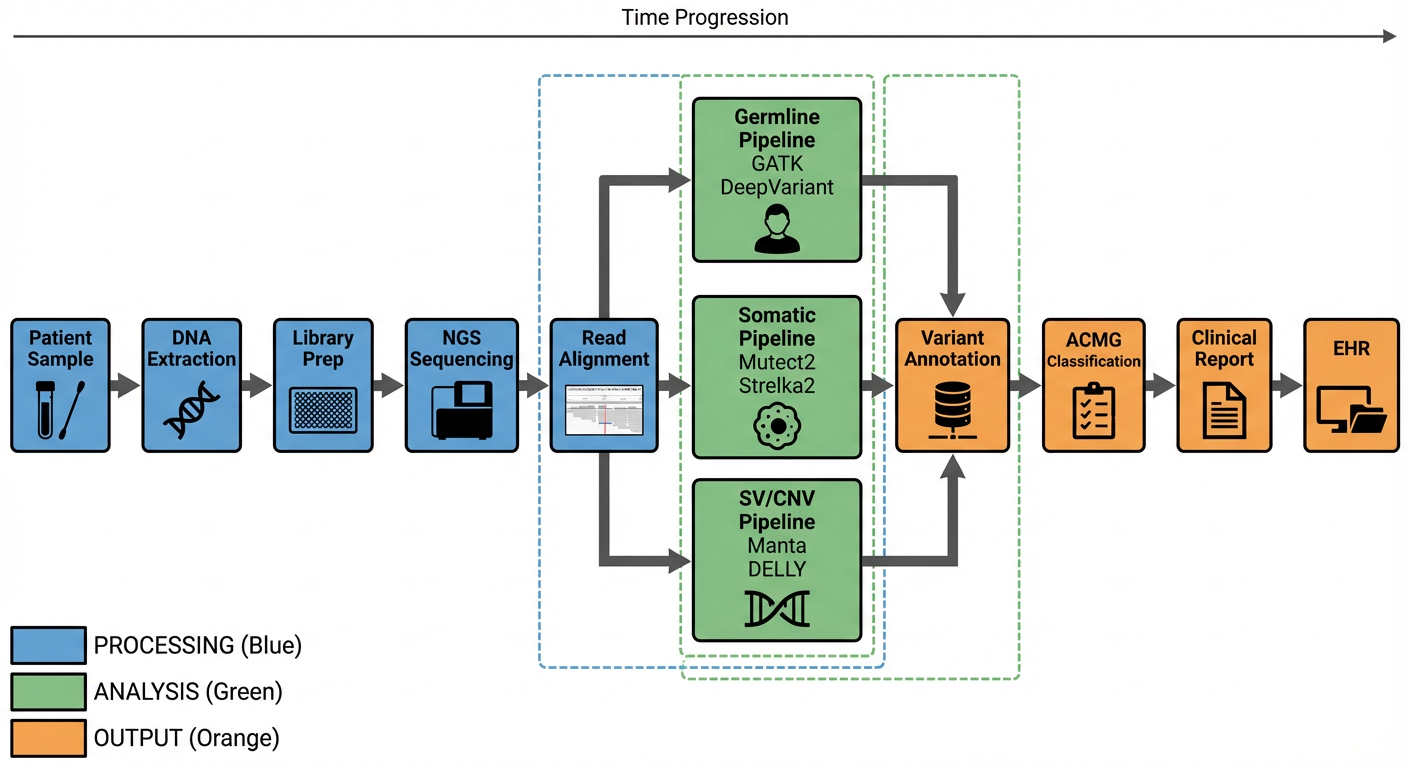
Chromosome 10 genotypes for all 2,504 individuals in 1000 Genomes Phase 3, on the GRCh37 build, were extracted after every supplied variant coordinate was re-verified against dbSNP; all three core positions turned out to be wrong and were corrected before extraction. Haplotype and predicted-phenotype frequencies were estimated for 5 super-populations and 26 sub-populations, alongside Hardy-Weinberg testing under Benjamini-Hochberg correction, linkage-disequilibrium analysis, tag fidelity scoring, and Wilson confidence intervals on per-population carrier rates. The results were converted into a six-trigger decision framework — two ancestry-based, two utility-based, two technology-based — plus a decision tree for when to escalate from the core panel to add-on variants or whole-gene sequencing, all documented in a 22-page report with 8 figures, 6 tables, and 32 verified references.
Data sources
- 1000 Genomes Project Phase 3, release 20130502 — GRCh37 chromosome 10 genotypes for 2,504 individuals across 5 super-populations and 26 sub-populations
- dbSNP — authoritative GRCh37 and GRCh38 coordinates for every assay variant
- PharmVar — canonical star-allele variant definitions for CYP2C19
- CPIC guideline record PA166251443
Limitations
The work is explicitly non-clinical and offers no prescribing, dosing, or diagnostic advice. Carrier rates are estimated from a reference panel rather than a clinical cohort, and because the canonical star allele 6 variant is missing from that call set, the diagnostic gap reported for African-ancestry populations is an underestimate.
Figures from this analysis
How this research was produced
K-Dense Web planned and ran this genomics investigation end to end — gathering the sources, carrying out the analysis, producing the figures, and drafting the report. The full session transcript, including every intermediate step, is available to view.