What this research found
Five proprietary drug leads were screened for liver-toxicity risk by training a gradient-boosted classifier on 6,258 compounds from the Tox21 SR-MMP high-throughput assay, with molecules encoded as Morgan circular fingerprints. The model reached a cross-validated ROC-AUC of 0.856, and ranking the leads by predicted toxicity probability separated the safest candidate at 7.8% from the riskiest at 33.4%. A SHAP analysis traced the riskiest lead's elevated score back to its quinazolinone core.
- The XGBoost classifier reached a mean ROC-AUC of 0.856 ± 0.027 across five stratified cross-validation folds (range 0.807–0.889), with recall of 0.684, precision of 0.409, and accuracy of 0.852.
- Predicted toxicity probabilities spread the five leads over a fourfold range: LEAD_002 at 7.8%, LEAD_003 at 9.3%, LEAD_004 at 15.5%, LEAD_001 at 17.6%, and LEAD_005 at 33.4%.
- Every lead fell below the 0.5 decision threshold and was therefore formally classed non-toxic, so the value of the exercise lies in the relative ranking rather than in any pass or fail verdict.
- LEAD_005 scores 0.197 above the model's expected value of 0.137, and SHAP assigns most of that gap to three fingerprint bits — 1912 at +0.337, 45 at +0.203, and 1380 at +0.175 — corresponding to nitrogen-heterocyclic and aromatic substitution patterns present in its quinazolinone core.
- On that basis the work recommends advancing LEAD_002 as the primary candidate and running structure-activity studies on LEAD_005 analogs with modified or replaced heterocyclic cores.
How it was done
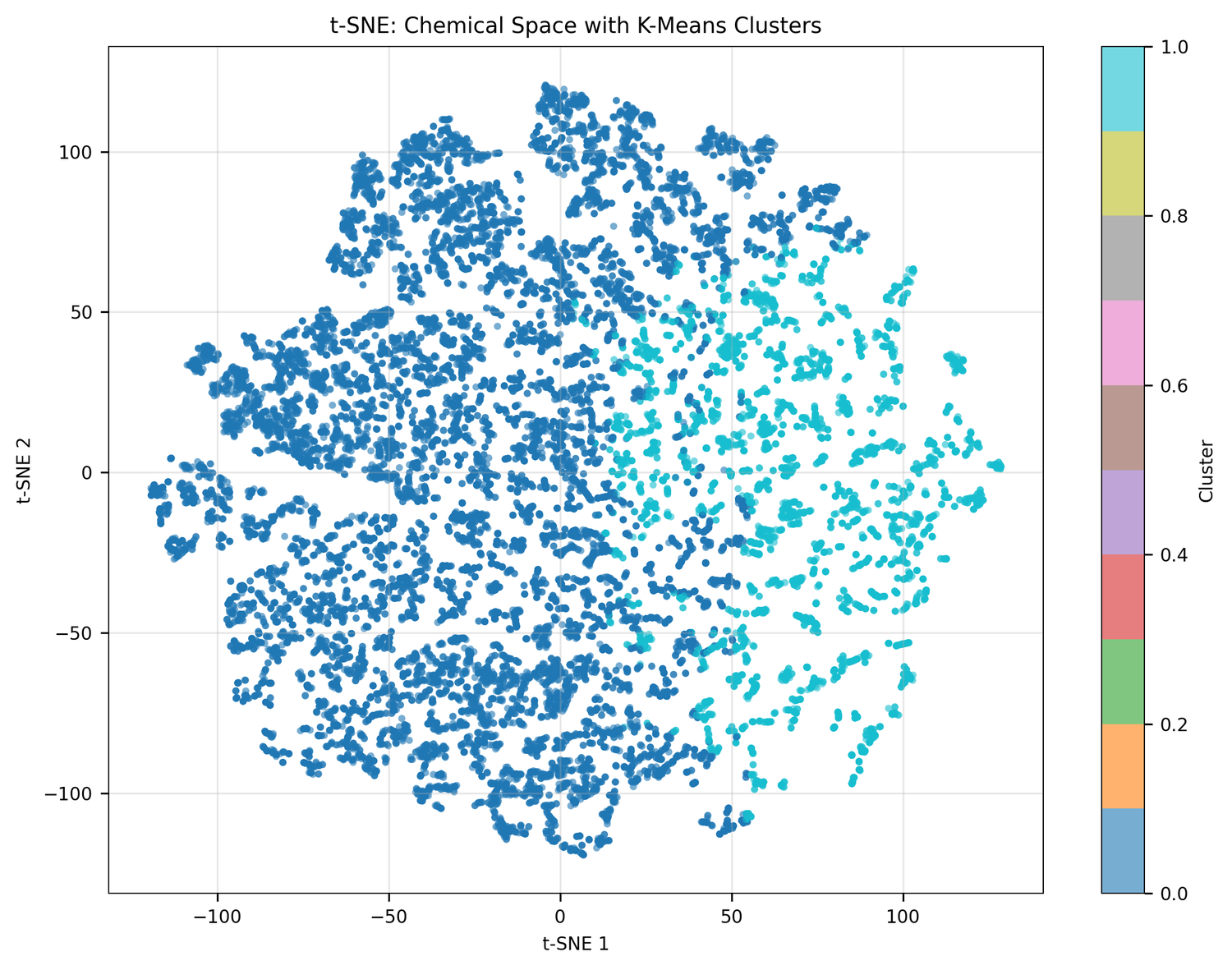
Tox21 screening data was retrieved from PubChem: 6,258 compounds of which 711 (11.4%) carried a toxic label, a 7.8:1 class imbalance. Each structure was encoded as a 2,048-bit Morgan circular fingerprint at radius 2, equivalent to ECFP4, and an XGBoost classifier was trained with scale_pos_weight set to 7.80 to offset the imbalance, then evaluated by five-fold stratified cross-validation. The fitted model scored five lead compounds supplied as SMILES strings, and a TreeExplainer SHAP pass on the highest-scoring lead identified which fingerprint bits drove its prediction and mapped them back onto the molecule. The write-up is a 13-page paper with 21 citations and six figures, including substructure highlights for the top-contributing bits.
Data sources
- Tox21 SR-MMP high-throughput screening data via PubChem — 6,258 compounds (711 toxic, 5,547 non-toxic)
- Five proprietary lead compounds supplied as SMILES strings
- Rogers & Hahn, Journal of Chemical Information and Modeling 50:742 (2010) — extended-connectivity fingerprints
- Lundberg & Lee, NeurIPS (2017) — SHAP feature attribution
Limitations
The binary label aggregates assay outcomes into a single endpoint, so the model cannot distinguish toxicity mechanisms, and no applicability-domain check was run to confirm that the leads resemble the training chemistry. Tox21 assays are cell-based, so these scores guide experimental priorities rather than substituting for in vivo testing.
Figures from this analysis
What this would have cost
This session was one of 67 audited against what a qualified specialist would spend producing the same deliverable alone, at mid-market US consulting rates.
Order-of-magnitude estimates (±30%) by design. The human baseline assumes one specialist working full-time without queueing or meetings, and excludes data and software licensing. The K-Dense figure is the credits a session consumed, valued at the Plus rate. What you are actually charged is capped per run — $9 at Standard, $29 at Pro — so the real gap is wider than shown. Full methodology.
How this research was produced
K-Dense Web planned and ran this toxicology investigation end to end — gathering the sources, carrying out the analysis, producing the figures, and drafting the report. The full session transcript, including every intermediate step, is available to view.