On September 8, OpenAI announced that one of its internal models had resolved the Navier-Stokes problem, one of the seven Millennium Prize Problems in mathematics. A swarm of AI agents produced the proof about 88 hours after the first ones were launched, and it was then checked in the Lean proof assistant. OpenAI was candid about why it was going public: "We believe it is important to inform the world about the pace of AI progress and what to expect from upcoming models" (OpenAI).
Less than three weeks later, the Quinnipiac University Poll asked 1,202 Americans how they felt about AI. Seventy-three percent said they were concerned that future AI systems could threaten human survival. Fifty-three percent expected AI to do more harm than good in their daily lives, 72% said they would oppose an AI data center in their community, and 74% said they had little or no trust in the leaders of AI companies. Tamilla Triantoro, a Quinnipiac business professor, put it plainly: "The industry needs to give people a reason to welcome AI" (Quinnipiac University Poll).
The industry's biggest showcase of the season was a theorem about fluids that experts are still working through. It does not even settle the version of the problem most mathematicians cared about. The public was asking a more immediate question: what will AI do for me?
Public fear of AI is high, still rising and often warranted. The most credible response is to solve problems people already care about, especially in science and health, and make those benefits visible. The frontier labs have the compute, talent and money to do that. They should devote far more of their resources to it.
The mood outside the tech bubble
Inside the AI industry, it is easy to believe the public is coming around. Usage is enormous, and OpenAI says ChatGPT now has more than a billion weekly active users (OpenAI). But people can use a product without trusting the people who make it. The polls show that trust is falling. In Pew Research Center's long-running question, the share of Americans who are more concerned than excited about AI in daily life rose from 37% in 2021 to 52% in June 2026, while the share who are more excited than concerned fell by half, from 18% to 9%. For the first time, a majority of adults under 30 (55%) say they are more concerned than excited (Pew Research Center).
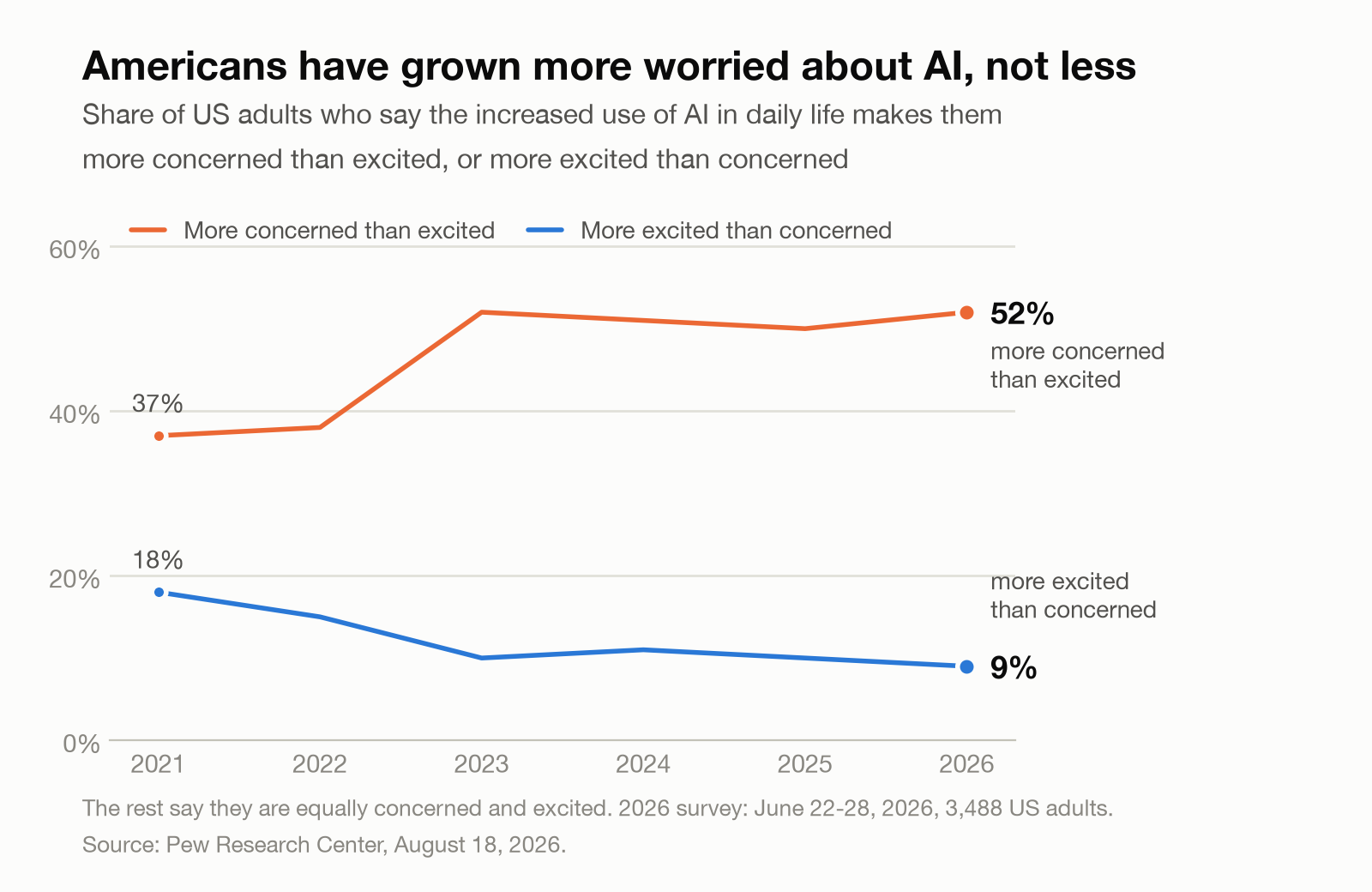 Figure 1. Concern about AI jumped in 2023 and has not come back down, while excitement has kept sliding. Data: Pew Research Center.
Other polls show a similar decline. The Bentley-Gallup survey found that the share of Americans who think AI does more harm than good rose from 31% in 2025 to 39% in 2026, against just 9% who think it does more good than harm (Gallup). An NBC News poll in March found that 26% of registered voters felt positive about AI and 46% felt negative; the only topics with a worse net rating were the Democratic Party and Iran (NBC News). AI experts are much more optimistic than the public. In Pew's 2025 comparison, 56% of AI experts expected AI to have a positive effect on the United States over the next 20 years, compared with 17% of the public (Pew Research Center).
The same frustration shows up in popular culture. Merriam-Webster's editors chose "slop" as their 2025 Word of the Year, defining it as "digital content of low quality that is produced usually in quantity by means of artificial intelligence" (Merriam-Webster). "Clanker," a Star Wars insult for robots, went mainstream the same year as a way to mock AI (NPR). Late-night television has turned AI into a running bit. John Oliver has devoted main stories to AI slop, some of which he called "potentially very dangerous," and, this April, to chatbots that he argued were rushed to market before they were ready (The Guardian, The A.V. Club). South Park went from crediting ChatGPT as a co-writer in 2023 to an episode last week in which Butters battles the "billionaire weenies" building data centers in his backyard (Wikipedia). And this week, Jon Stewart used The Daily Show to needle AI executives who warn about the technology's dangers but struggle to say what the public gets in return (BroadwayWorld).
Opposition to data centers has delayed construction. Data Center Watch, which tracks local opposition, counted at least 75 data center projects worth about $130 billion blocked or delayed in the first quarter of 2026 alone, while the number of active opposition groups more than doubled to 833 across 49 states (Data Center Watch). Just 11% of voters told NBC News they would be more likely to back a candidate who supported building a data center locally (NBC News). That opposition reaches well beyond the jokes and insults. People are trying to stop the industry from building in their communities.
Much of the fear is earned
People are judging AI by what it has done to them and around them. A lot of what they have seen is bad, and better marketing will not fix that.
Stanford's Digital Economy Lab finds no economy-wide job displacement from AI so far. But employment of 22- to 25-year-olds in the most AI-exposed occupations now stands about 19% below where it would be had it kept pace with their less-exposed peers, and that gap has widened steadily since the researchers first reported it in 2025 (Stanford Digital Economy Lab). Employers cited AI in 120,136 announced job cuts through September 2026, about 21% of the total, which makes it the leading stated reason for layoffs this year (Challenger, Gray & Christmas). Some of that is what Sam Altman has called "AI washing," companies blaming AI for cuts they would have made anyway (Business Insider). The industry's own warnings are more alarming still. In May 2025, Anthropic's CEO, Dario Amodei, said AI could wipe out half of all entry-level white-collar jobs and push unemployment to 10 to 20% within one to five years (Axios). The public has taken the builders at their word: 71% of Americans now expect AI to mean fewer jobs over the next two decades (Pew Research Center).
Chatbot use among vulnerable people raises other concerns. In October 2025, OpenAI estimated that in a given week about 0.15% of ChatGPT users have conversations with explicit indicators of potential suicidal planning or intent (OpenAI). With roughly 800 million weekly users at the time, that worked out to about 1.2 million people every week (The BMJ). The parents of Adam Raine, a 16-year-old who died by suicide in April 2025, allege in a lawsuit that ChatGPT validated his plans; OpenAI denies that it caused his death (complaint, NBC News). In January, Google and Character.AI agreed to settle lawsuits brought by families over teen suicides and other harms (CNBC). A study in JAMA Psychiatry this year found that none of the tested versions of ChatGPT reliably responded appropriately to prompts describing psychotic symptoms (JAMA Psychiatry). And Reuters reported that Meta's internal rules had allowed its chatbots to "engage a child in conversations that are romantic or sensual," passages Meta removed after the news agency asked about them (Reuters).
Image tools have also been used to sexualize real people. Over 11 days around the new year, Grok generated an estimated 3 million sexualized images on X, including roughly 23,000 that appeared to depict children, according to a sampling analysis by the Center for Countering Digital Hate (CCDH). Britain's Ofcom opened a formal investigation within days (Ofcom).
Data center demand is also raising electricity bills. In PJM, the grid operator serving 13 states and Washington, DC, the independent market monitor attributes $29.4 billion of the $63.6 billion in capacity charges from the last four auctions, or 46%, to data center demand (Utility Dive). Those charges reach households. New Jersey regulators told residents to expect bill increases of 17 to 20% in 2025, named the PJM capacity auction as "the main driver," and pointed to demand growth "driven by data center growth and other factors" (New Jersey Board of Public Utilities).
The people building AI have issued warnings of their own. Amodei wrote in January that "we are considerably closer to real danger in 2026 than we were in 2023" (Dario Amodei). Altman, Amodei and Google DeepMind's Demis Hassabis all signed the 2023 statement that "mitigating the risk of extinction from AI should be a global priority alongside other societal-scale risks such as pandemics and nuclear war" (Center for AI Safety). The public has good reason to take those warnings seriously.
Some fears are overstated. Data center water use is smaller than its reputation, some layoffs blamed on AI are opportunistic, and the effect on power prices is regional rather than national. Even so, most people encounter AI through its side effects: a chatbot that flatters a struggling teenager, a feed full of slop or a fake image of a classmate. Others see it named in a layoff memo or feel it in a higher electric bill. The benefits tend to be abstract, hard to see or happening to someone else.
The public already told us what it wants
The same polls show that Americans want AI used for some tasks and kept out of others. When Pew asked in June 2025 how much of a role AI should play in different parts of life, 74% said it should play at least a small role in forecasting the weather, 70% in searching for financial crimes and 66% in developing new medicines. By contrast, 73% said AI should play no role at all in advising people about their faith, 66% said no role in judging whether two people could fall in love, and 60% said no role in governing the country (Pew Research Center topline). In Pew's words, Americans "overwhelmingly reject AI's involvement in more personal aspects of life" (Pew Research Center) but show "some receptiveness to AI doing heavy analytical tasks in the scientific, financial and medical realms" (Pew Research Center).
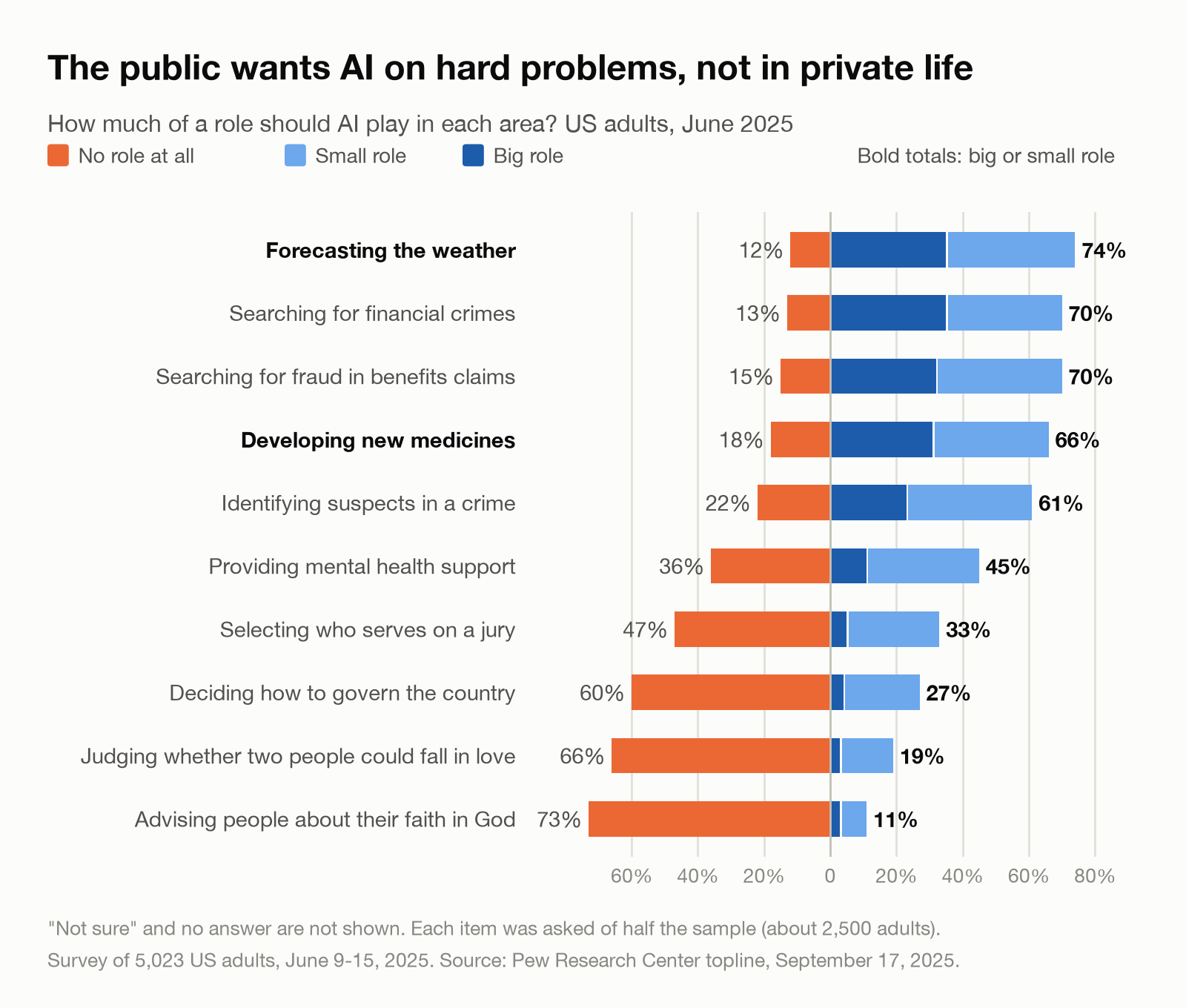 Figure 2. The public draws a clear line: AI is welcome on heavy analytical problems and unwelcome in private life. Data: Pew Research Center topline.
Health stands out. In the same 2025 comparison of experts and the public, Pew found that medical care is "the one area in which the public is most optimistic about AI's impact," with 44% of Americans expecting a positive effect, compared with 21% for the economy and 23% for how people do their jobs (Pew Research Center). Many people already turn to chatbots for health questions. OpenAI says more than 230 million people ask ChatGPT health and wellness questions every week (OpenAI), and 34% of American adults say they have used a chatbot for at least one health reason, from understanding lab results to deciding whether to see a doctor (Pew Research Center).
People are most open to AI doing difficult analytical work in areas such as weather, fraud and medicine, where the problems are too big for any one person. Yet the most heavily promoted consumer products focus on companionship, entertainment feeds and personal advice, uses that draw some of the strongest public resistance. The industry is promoting products in areas where people are least willing to trust it.
Results people can understand
Over the past few years, AI has started to produce results in science and health that anyone can understand without a math degree. Many have been tested in rigorous trials.
Take breast cancer screening. In Sweden's MASAI trial, the first randomized trial of AI in mammography screening, more than 100,000 women were assigned either to standard double reading by two radiologists or to AI-supported screening. Earlier analyses showed that the AI arm found 29% more cancers without more false positives and cut radiologists' reading workload by 44% (The Lancet Digital Health, The Lancet Oncology). The final results, published in The Lancet in January, showed 12% fewer interval cancers (the ones that surface between screenings and tend to be more dangerous) and 27% fewer of the aggressive subtypes. The interval-cancer reduction met the trial's non-inferiority goal but was not statistically significant on its own, and the subtype comparison was descriptive only (The Lancet, EurekAlert!). In Germany, a real-world study of 463,094 women found that screens read with an AI-supported viewer detected 17.6% more cancers with no rise in recalls (Nature Medicine).
In a pragmatic randomized trial in Taiwan, an AI that read routine electrocardiograms and alerted physicians to high-risk patients was associated with a drop in 90-day all-cause mortality from 4.3% to 3.6% among 15,965 hospitalized patients (Nature Medicine). Mortality is medicine's hardest endpoint. This randomized trial found a difference in how many patients died.
Weather forecasting also has public support. The 2025 Atlantic season was the first in which the US National Hurricane Center used AI models in real-time operations, and it called the Google DeepMind model "very useful." For Hurricane Melissa, the NHC gave almost three days of notice that the storm would hit Jamaica as a Category 5, the first time it had forecast Category 5 strength from a Category 1 starting point, and it credited improved regional models and emerging AI ensembles with giving forecasters the confidence to make such an aggressive call (National Hurricane Center). Google's river flood forecasts now cover 2 billion people in more than 150 countries (Google).
Progress in drug discovery takes longer. Generative AI identified both the target and the molecule for rentosertib, a drug for idiopathic pulmonary fibrosis, a disease that scars the lungs. At its highest dose, the drug showed better lung function than placebo in a small 12-week Phase 2a trial. The first patient in its Phase 3 trial was dosed last month (Nature Medicine, Insilico Medicine). MIT researchers used generative AI to design antibiotics with structures unlike existing ones. They worked against drug-resistant gonorrhea and MRSA infections in mice. Drug-resistant bacterial infections are linked to nearly 5 million deaths a year (MIT News). David Baker's lab designed proteins from scratch that neutralized lethal snake venom toxins and protected mice. The authors say such designed proteins could lead to safer, cheaper and more widely accessible antivenoms (Nature). AlphaFold, whose creators shared the 2024 Nobel Prize in Chemistry, now has more than 3.4 million users in 190 countries through its open database (EMBL-EBI).
Joseph Coates had POEMS syndrome, a rare blood disorder, and was facing hospice care when his doctors tried a drug combination that an early version of Every Cure's repurposing algorithm had ranked highly. He responded within a week and went on to remission (The New York Times, Every Cure). His recovery is an anecdote, not proof that the treatment works. It is still a result any family can understand.
Trials have also found failures and limits. A large NHS trial of an AI stethoscope across 205 primary care practices did not significantly increase heart failure detection, and use of the device declined over time as clinicians ran into workflow barriers (The Lancet). A randomized trial of an AI clinical copilot in Kenyan clinics improved documentation but did not significantly reduce treatment failures (Nature Medicine). In an observational study, endoscopists who had grown used to AI assistance found fewer precancerous growths when working without it (The Lancet Gastroenterology & Hepatology). Those results help explain why this work needs trials and why it takes time. The successes address problems families recognize: cancers caught earlier and hurricanes forecast sooner, as well as infections that resist existing drugs and diseases with no good treatment.
Why the showcase keeps being math
Many of AI's biggest announcements involve mathematics for a sound engineering reason: a proof is either right or wrong, and a proof assistant like Lean can check it mechanically. That gives researchers a cheap, unambiguous reward signal for training, without recruiting patients or dealing with ethics boards, wet labs or regulators. AI founders are explicit about the appeal. Carina Hong of Axiom Math calls math "the perfect sandbox for building superintelligence" (Forbes), Math Inc's motto is "Solve math, solve everything" (Math Inc), and investors valued Axiom at more than $1.6 billion in March (Axiom).
The work has produced real results. In July 2025, an advanced version of Google DeepMind's Gemini Deep Think earned an officially certified gold-medal score at the International Mathematical Olympiad, two days after OpenAI announced its own gold-level result without official grading (Google DeepMind). DeepMind's AlphaEvolve found a way to multiply 4-by-4 complex matrices with 48 multiplications, improving on a 56-year-old algorithm in that setting, and a scheduling heuristic it found now recovers about 0.7% of Google's worldwide compute (Google DeepMind). That compute saving is a practical benefit.
The public claims about these results have sometimes gone well beyond the evidence. In October 2025, an OpenAI vice president posted that GPT-5 had found solutions to 10 previously unsolved Erdős problems. It had actually found existing papers that already solved them. Thomas Bloom, who maintains the Erdős problems database, called the claim "a dramatic misrepresentation," and Hassabis replied, "This is embarrassing" (TechCrunch). Genuine AI results on Erdős problems have since arrived, but Terence Tao has pointed out that systematic studies put the success rate of these tools at "maybe 1% or 2%" on any given problem, and that "if you only focus on the success stories, the ones that get broadcast on social media, it looks amazing" (Dwarkesh Podcast).
OpenAI's Navier-Stokes result is a real technical feat that satisfies one of the official Clay Institute formulations of the problem. But that formulation allows an external force, and the proof depends on a contrived one. "The Clay problem is settled, but the main problem for the Navier-Stokes equations is not," the University of Chicago mathematician Luis Silvestre told Scientific American, and a follow-up paper by three mathematicians argues that the method can never be extended to the force-free case most researchers care about (Scientific American). Science described the aftermath as an "existential crisis" in math. More than 1,000 mathematicians signed an open letter accusing AI companies of "research misconduct" over a student "mathathon" backed by AI companies, Tao wrote that "even the rumor of someone working on a problem can trigger a massive amount of AI-powered effort to flatten it," and 25 Fields medalists published a declaration warning of a "severe misalignment" between AI and mathematics (Science, Math and AI).
OpenAI said the point was to "inform the world about the pace of AI progress," a message aimed at investors, competitors, policymakers and rival labs who track those capabilities. Everyone else learned that AI is extraordinarily good at something they cannot evaluate, on a problem they had never heard of, and that many of the experts who could evaluate it were alarmed. Even if every result holds up, the benefit is hard to see for a family worried about a parent's diagnosis. "Solve math, solve everything" asks the public to accept a long chain of reasoning on faith, at a moment when three in four Americans say they have little or no trust in the people asking.
Math deserves a central place in AI research as a training ground, and formal verification may one day make AI-generated science far more trustworthy. But mathematical prestige alone gives the public little reason to want the technology. A cancer caught early makes its value much easier to understand.
Follow the compute
The leaders of the frontier labs have promised major advances in health. Amodei's 2024 essay predicted that "AI-enabled biology and medicine will allow us to compress the progress that human biologists would have achieved over the next 50-100 years into 5-10 years" (Dario Amodei). Hassabis told 60 Minutes that the end of disease is "within reach. Maybe within the next decade or so" (CBS News). Altman wrote that "maybe with 10 gigawatts of compute, AI can figure out how to cure cancer" (Sam Altman). So far, their products and spending have done little to match those promises.
When OpenAI launched its Sora video app in 2025, critics called it a slop machine. Altman's defense was revealing: "we do mostly need the capital for build AI that can do science, and for sure we are focused on AGI with almost all of our research effort. it is also nice to show people cool new tech/products along the way, make them smile, and hopefully make some money given all that compute need" (Sam Altman on X). The app reportedly burned about $1 million a day before OpenAI shut it down this spring (TechCrunch). OpenAI also announced and delayed an adult mode for ChatGPT, then, according to the Financial Times, shelved it (CNET), and its new ads business reached a $1 billion annualized run rate in under 200 days (OpenAI). Meta put a feed of AI-generated videos at the center of its AI app (Meta).
OpenAI's science initiative was less secure. This spring, the company cut back on what was reported as "side quests," including both Sora and OpenAI for Science. In April, the head of the science initiative left, and the group was folded into other research teams just one day after releasing GPT-Rosalind, a model built for life sciences research (TechCrunch). OpenAI says about 1.3 million people a week use ChatGPT for advanced science and mathematics (OpenAI). Against more than a billion weekly users, that is roughly one in a thousand.
The labs are doing more for science than they were two years ago, and some of the work is excellent. Google DeepMind developed AlphaFold and drove much of the progress in AI weather forecasting. Its drug discovery spinout, Isomorphic Labs, raised $2.1 billion in May (R&D World). Anthropic launched the Claude Science research workbench and opened 10,000 free or discounted seats for scientists. It offers up to $50,000 in research credits per project. Last month, it reported that Claude had spotted a new enzyme system with CRISPR-like features, though its function is not yet known (Anthropic, Anthropic, Anthropic). OpenAI has committed more than $250 million through 2027 to external scientific research, including free access for academic researchers (OpenAI). The OpenAI Foundation has pledged $25 billion toward health, curing diseases and AI resilience (OpenAI) and has announced health programs that include more than $100 million for Alzheimer's research, more than $125 million for public health data and $100 million for the Common Health Coalition (OpenAI Foundation, OpenAI Foundation, AHA News).
These commitments are welcome, though small compared with the industry's spending. Four of the largest US technology companies said in February that they expected to spend about $650 billion on capital projects this year, money earmarked for new data centers and the hardware inside them (Bloomberg). The National Institutes of Health, the largest public funder of biomedical research in the world, had a budget of about $46.5 billion in fiscal 2026, and the White House has asked Congress to cut it by $5 billion for fiscal 2027, which began October 1 (NIH). That request follows a year in which the agency terminated 2,291 active research grants (PNAS).
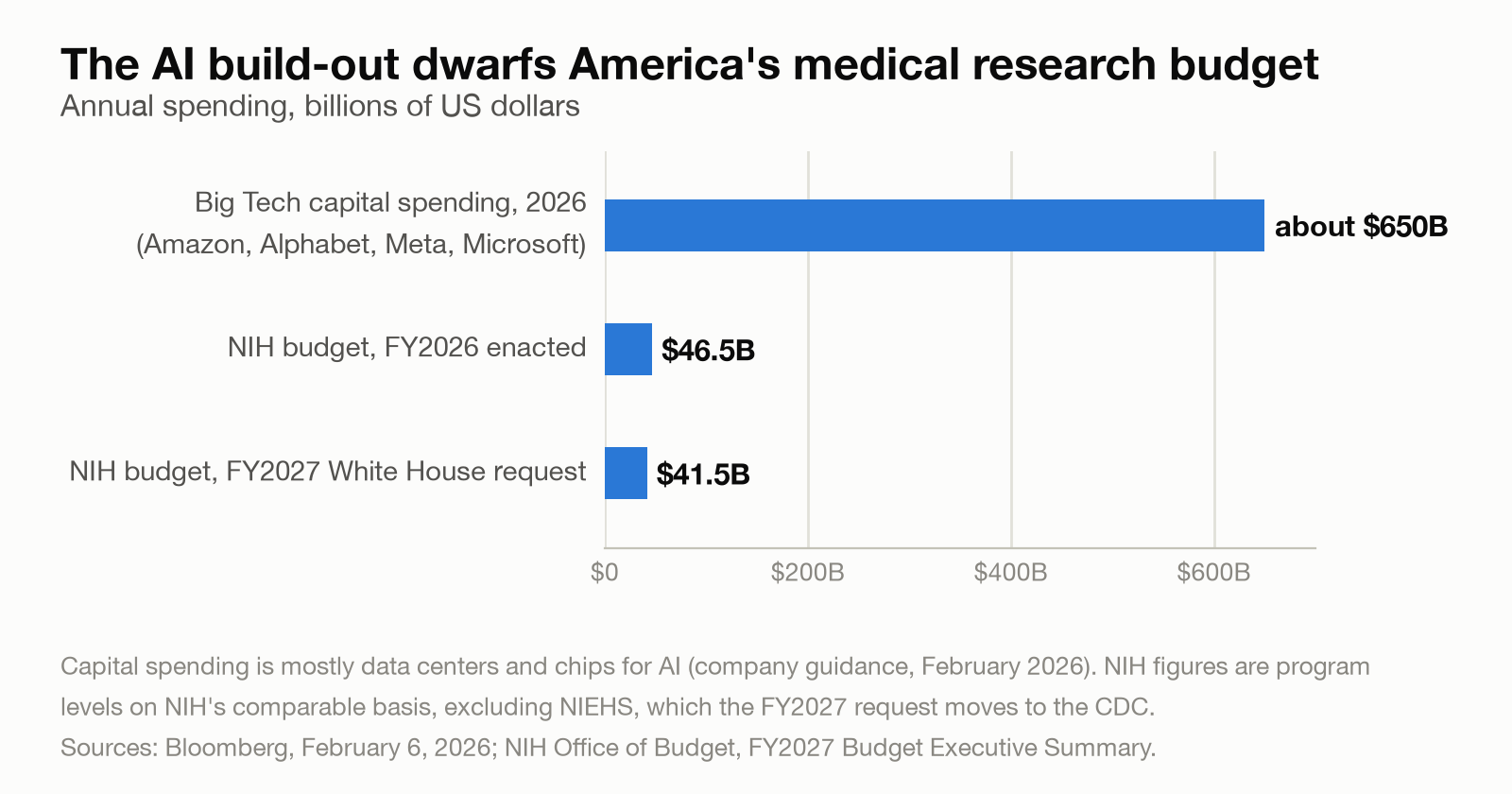 Figure 3. One percent of this year's Big Tech capital spending would be about $6.5 billion, more than the entire cut proposed for the NIH. Data: Bloomberg, NIH Office of Budget.
Capital spending and research funding are different kinds of expenditure, so the comparison is imperfect. Still, a small share of a frontier lab's compute budget could make a substantial difference to public science. Whether the labs choose to spend it there is up to them.
Six commitments the labs could make
A promise to "do more for science" gives the public no way to judge whether a lab has kept it. Labs should make commitments that people outside the industry can check.
- Commit a fixed fraction of frontier compute, say 10%, to open problems in science and health. Report that share every year, as companies do with emissions. Compute is the scarce input the labs control, and a public number makes the promise checkable.
- Pick problems people recognize: antibiotic resistance, early cancer detection, Alzheimer's, sepsis, snakebite, hurricanes and floods. Include rare diseases too. Of the 17,080 diseases covered by one Harvard drug repurposing model, 92% have no FDA-approved drug (Nature Medicine). Publish the list, the milestones and the misses.
- Fund the trials, assays and regulatory work needed to turn a proposed molecule into a medicine. The results above took prospective trials, lab validation and years of patience; MASAI alone enrolled more than 100,000 women. Publish the null results too. We learned from the AI stethoscope and Kenyan copilot trials because their findings were reported.
- Report cancers detected, patients enrolled, forecasts verified and drugs advanced with the same precision used for benchmark scores. Let independent groups audit the numbers so people can see what changed.
- Strengthen public science by expanding academic access programs by an order of magnitude and partnering with publicly funded labs on research problems. Publish a disbursement schedule for the OpenAI Foundation's $25 billion pledge.
- Give vetted researchers access to the best models, with audits of how they use them. The same capabilities that design an antivenom could help design a toxin, which is why Anthropic blocks professional biology and drug development queries on its generally available Fable models (Anthropic). In September, it opened a beta program that verifies life science teams and gives them access to its Mythos, Opus and Sonnet models with more permissive safeguards and usage monitoring (Anthropic). That is the kind of safe path legitimate researchers need. It should grow well beyond a beta, and every frontier lab should offer one.
Labs can make these commitments while continuing to train on math and build consumer products. Science and health should become priorities in their own right.
Give people a reason to trust AI
The industry has a financial stake in earning that trust. Public resentment can shape regulation, and useful scientific work may be one of its cheapest ways to reduce that risk. In the Quinnipiac poll, 86% of Americans supported requiring AI companies to meet independent safety standards even if that slows development, and nearly eight in 10 wanted powerful AI development slowed or stopped until its safety can be evaluated (Quinnipiac University Poll). An industry asking for permission to build at this scale needs people who can point to something AI did for them.
The polls show that people want AI forecasting the weather and developing medicines, and that they are most hopeful about its role in medical care. A woman whose cancer is found during screening, or a town that evacuates a day earlier because of an accurate forecast, has a concrete reason to value it. If people know AI helped, enough of those experiences would do more for trust than benchmark charts or Millennium Prize announcements.
That is the work we want to support at K-Dense. Our AI co-scientist is designed to help researchers analyze real data and leave evidence they can inspect. Examples include work to estimate how common hidden iron deficiency is in US women, map 3,629 TP53 mutations against function and pull together the evidence on hantavirus. We are a small company; this work alone will not move a national poll. The frontier labs have far more compute and talent, along with the public's attention. They have already promised to put those resources to work. If AI wants the public's trust, it should cure something, and let people see it happen.
Related reading:
- AI Co-Scientist, Not AI Scientist: Why the Name Matters
- The Week Science Models Became Real
- The Model Is No Longer the Bottleneck
- Reproduction, Not Generation, Is AI's Killer App for Science
- AI Scientists Need Lab Escape Rooms, Not More Exams
- The AI Co-Scientist Is Here. The Bottleneck Is Verification.